.png)
The 2 AM Problem: Why AI in Healthcare Needs More Than Task Completion
At 2 a.m., a patient with chest pain doesn’t need scheduling, they need urgency, empathy, and escalation. This piece explores why first-generation healthcare AI fails in critical moments and what it takes to build systems that recognize risk, act responsibly, and integrate safely into real clinical workflows.
A patient calls the hospital at 2 a.m., worried about chest pain radiating to their left arm.
The AI, brilliantly optimized for scheduling, replies:
“I can book you with cardiology. The earliest appointment is Tuesday at 10 a.m.”
Technically accurate. Operationally efficient but clinically dangerous.
Scheduling the appointment was the easy part. The harder question is: what else did that interaction miss?
A system optimized for task completion, booking a slot, confirming a time, has no awareness of the patient sitting behind that request. It doesn't catch the hesitation. It doesn't flag the risk. It doesn't connect the dots between a missed follow-up and a deteriorating condition.
That's the fundamental design flaw in first-generation healthcare AI. It was built to close tickets, not to understand people.
Real patient access requires more. It requires AI that can hold a genuine conversation, read context, and know when a clinical or human escalation is the right call, not just the efficient one.
Unlike retail or travel, healthcare conversations are different because there's more at stake. One wrong piece of advice could have serious consequences. A missed intent can mean a missed diagnosis. A poorly sequenced question can delay urgent care. A neutral tone can feel dismissive in a moment of fear.
Designing these systems isn’t about making chatbots more “friendly”. It’s about building agents that recognize risk, escalate appropriately, communicate uncertainty clearly, and act within ethical and clinical guardrails.
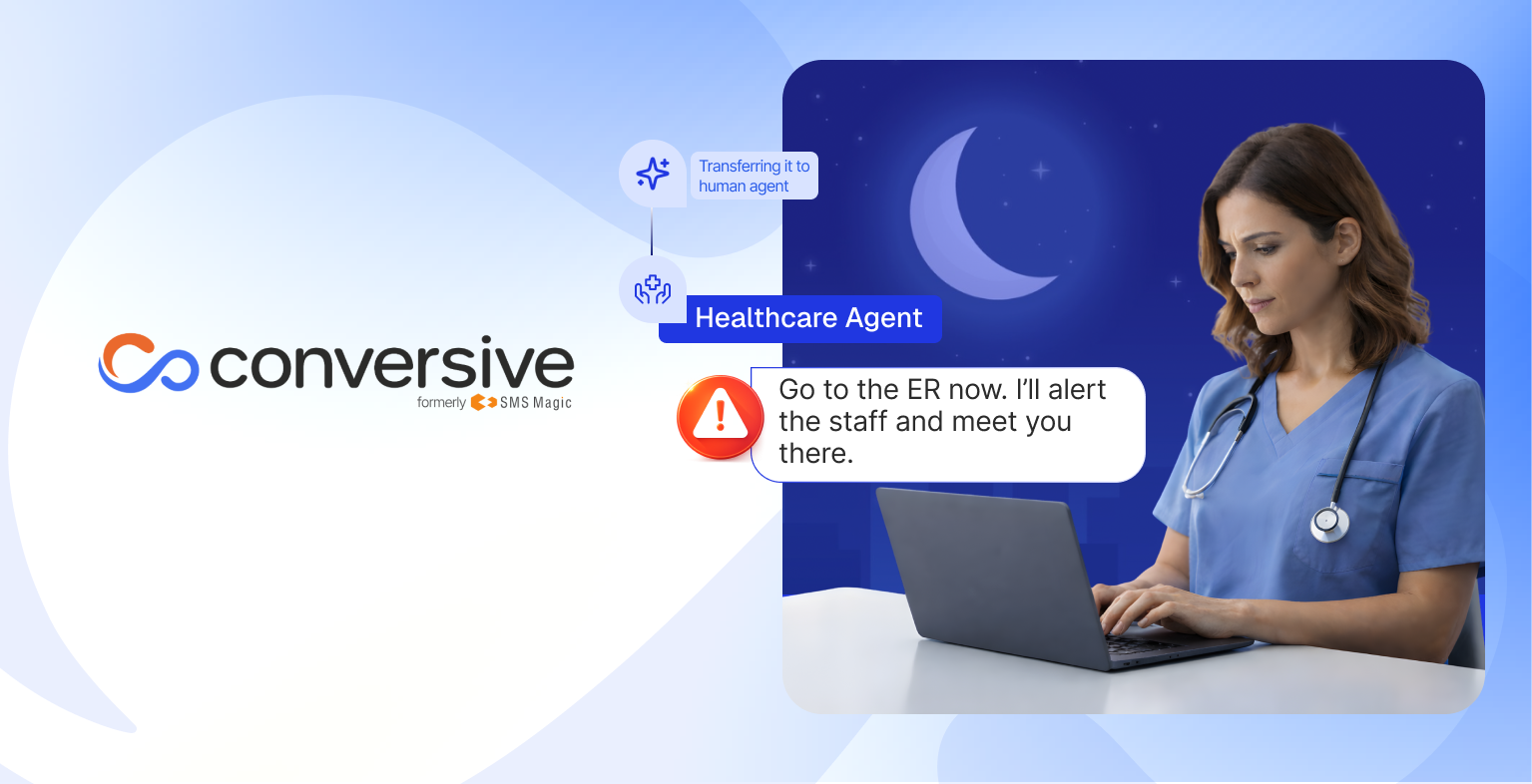
At 2 a.m., the appropriate response is not simply scheduling, it’s something more like this:
- Recognizing that these are serious symptoms that require urgent attention.
- Checking the patient’s symptoms against emergency guidelines.
- Urging the patient to go to the emergency room immediately due to the danger signs.
- Offering appropriate support and escalating the case to human agents.
That requires more than clever prompts. It requires deep collaboration between clinicians & safety experts. It requires mapping risk states, designing escalation protocols, testing edge cases and continuously monitoring real-world performance. It requires building for ambiguity, not just happy paths.
Healthcare conversation design lives at the intersection of empathy and responsibility.
The systems must be:
- Safe: able to detect and escalate high-risk signals.
- Transparent: clear about limitations and uncertainty.
- Context-aware: sensitive to emotional state and situational urgency.
- Operationally integrated: aligned with real clinical workflows, not just surface interactions.
When conversation design fails in retail, someone abandons a cart. When it fails in healthcare, someone may delay calling emergency services.
Conversive Turns Conversations Into Clinically Intelligent Action
If you are building or deploying conversational systems in healthcare, the question isn’t if AI can answer questions or book appointments, but if your system can recognize urgency at 2 a.m., escalate safely, communicate uncertainty responsibly, and integrate into real clinical workflows without breaking trust.
That level of capability doesn’t happen by accident. It requires intentional conversation architecture, mapping risk states, designing escalation pathways, embedding consent into dialogue, aligning with regulatory frameworks, and continuously monitoring real-world performance. It requires treating conversation design as a clinical safety function, not a UX afterthought.
This is exactly where Conversive operates.
Conversive works with healthcare organizations to design and deploy AI agents that do more than automate tasks. We build systems that understand latent intent, detect high-risk signals, adapt language to context, and orchestrate next best actions across channels. Every flow is designed with human override pathways, transparent AI identity, and operational integration at its core.
If your organization is exploring how to deploy AI responsibly, or if you want to audit whether your current conversational systems are truly healthcare-grade, we would welcome the conversation.
Book a demo with us to see what responsible, clinically intelligent conversation design looks like in practice.


.png)

Explore More