.png)
How Conversation Intelligence Reveals Insights Across Every Customer Interaction
Turn calls and chats into insights that drive revenue, reduce risk, and improve service. Learn how Conversation Intelligence works and why it’s essential in 2026.
Every day, your business generates a goldmine of conversation data from sales calls to customer service chats, from support tickets to WhatsApp threads. Yet most of it goes unused, buried in call recordings, scattered notes, or siloed systems.
But you can change that by using AI to transcribe, analyze, and tag customer interactions across channels. You can get insights like what top performers say, how buyers respond, where customers get frustrated, and when compliance risks arise using Conversational Intelligence platforms.
Unlike chatbots or messaging tools designed to handle live interactions, Conversational Intelligence focuses on what’s already been said. It transforms raw audio and chat logs into structured data that teams can act on whether it’s coaching a rep, identifying churn risks, or uncovering unmet product needs.
What Is Conversation Intelligence?
Conversation Intelligence (CI) is the use of AI to transcribe, analyze, and extract insights from customer interactions whether via phone calls, video meetings, chats, or messaging platforms. Unlike call recording tools that simply store audio, CI platforms interpret the conversation to reveal trends, risks, and opportunities.
By turning voice and chat data into structured insights, CI enables companies to improve how they sell, support, and respond. It helps sales managers understand why deals are won or lost. It flags customer frustration early, tracks compliance language, and highlights what features users care about most.
Most conversation intelligence systems follow a four-step pipeline to convert raw input into usable insight:
Step 1: Audio Input or Chat Capture
CI tools ingest voice calls (e.g., phone, Zoom, VoIP) or digital chats (e.g., live chat, WhatsApp, SMS).
Step 2: Real-Time Transcription and Speaker Separation
Speech recognition models transcribe conversations as they happen or just after while identifying who’s speaking at each moment.
Step 3: Sentiment Tagging and Keyword Extraction
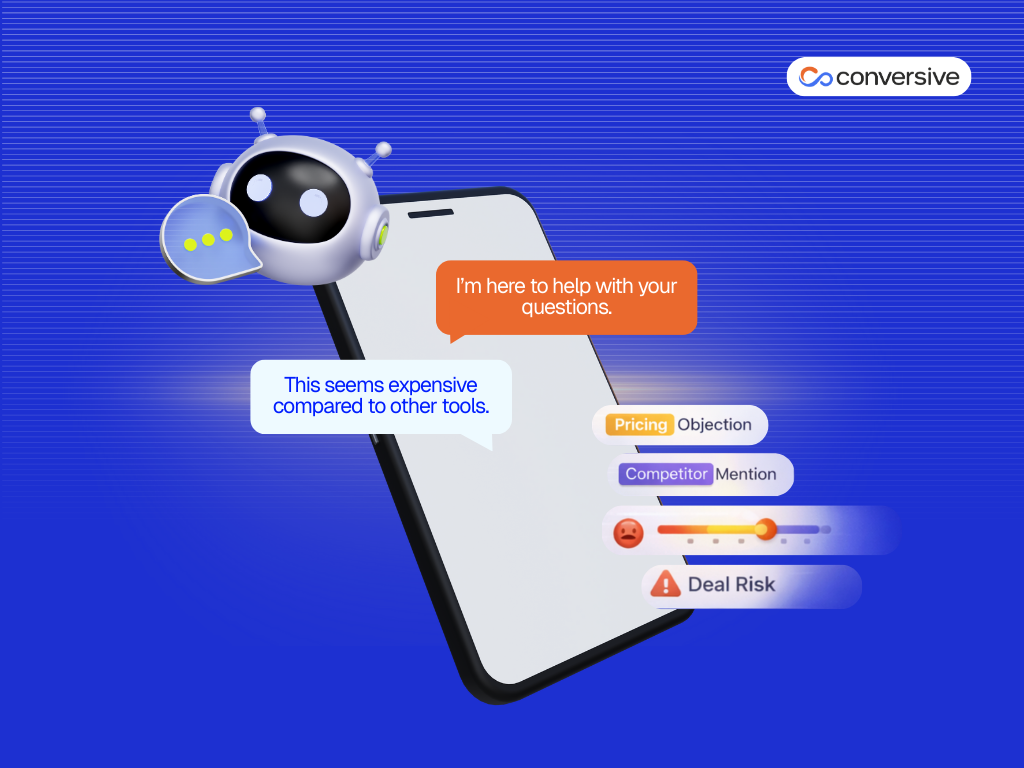
The system analyzes tone, highlights important phrases (e.g., pricing objections, competitor mentions), and flags key behaviors like interruptions or long silences.
Step 4: Insight Delivery and Alerts
Insights are surfaced via dashboards, notifications, or CRM updates turning each conversation into a source of revenue intelligence, coaching material, or customer feedback.
Conversation Intelligence vs. Conversational AI
Though they sound similar, Conversation Intelligence (CI) and Conversational AI serve different purposes. Conversational Intelligence is about listening and learning from past interactions. Conversational AI is about engaging in real-time, often as the first line of customer interaction.
A chatbot that answers billing questions or an AI assistant that books appointments live is an example of Conversational AI. It’s designed to participate in conversations. In contrast, Conversation Intelligence sits in the background analyzing what was said in those conversations to surface patterns, risks, and coaching opportunities.
Both use natural language processing (NLP) and machine learning, but they are applied at different stages of the customer journey. CI is retrospective and analytical; Conversational AI is real-time and responsive.
Here are the key differences between Conversational Intelligence and Conversational AI:-
Strategic Benefits of Conversation Intelligence
Conversation Intelligence is an insight engine that transforms unstructured conversations into structured data enabling smarter decisions across sales, service, and operations. It helps teams improve performance, reduce churn, and align better with what customers actually say:-
i) Improve Sales Coaching and Agent Training
Conversational Intelligence gives sales leaders more than just call recordings, it delivers specific, actionable insights that make coaching less subjective and more effective.
- Spot coachable moments from real calls. Managers can pinpoint when a rep mishandled an objection, missed a cue, or failed to ask a qualifying question.
- Share winning talk tracks across teams. By analyzing high-performing reps, CI helps standardize best practices and language that consistently drive conversions.
- Track key metrics like talk-to-listen ratio. This helps sales teams balance conversations, reducing monologues and increasing customer engagement.
These coaching benefits scale as teams grow, giving every manager the ability to train based on data, not just instinct.
ii) Monitor Sentiment and Compliance Across All Channels
Beyond sales, Conversational Intelligence plays a critical role in compliance-heavy and customer support environments, where understanding tone and script adherence can make or break trust.
- Identify risk language or dissatisfaction early. Sentiment tagging helps managers catch negative conversations before they escalate.
- Surface churn signals proactively. Frequent mentions of delays, unresolved issues, or competitor products can indicate dissatisfaction that hasn’t yet been voiced outright.
- Ensure script adherence in regulated industries. In finance, healthcare, or legal, CI confirms whether mandatory statements were delivered properly.
This allows compliance teams and CX leaders to track risk in real time without manually auditing hours of audio.
iii) Capture and Operationalize the Voice of the Customer
Perhaps the most strategic benefit of Conversational Intelligence is how it turns day-to-day conversations into feedback loops for product, marketing, and customer experience teams.
- Extract trends in customer pain points or feature requests. Instead of waiting for survey responses, product teams can pull real issues from actual calls and chats.
- Tag and aggregate mentions of competitors. These mentions help marketing and sales refine positioning and understand what messaging isn't landing.
- Turn unstructured calls into structured insights. Themes and tags from conversations can be linked to deal outcomes, support resolutions, or NPS scores.
This closes the gap between frontline interactions and back-office decision-making giving the entire organization clearer visibility into what customers care about most.
Must-Have Features in a Conversation Intelligence Platform
Many Conversational Intelligence tool promise transcription and sentiment analysis, few offer the depth and precision required for regulated, service-centric, or cross-functional use cases. Whether you're evaluating a platform for sales coaching, compliance, or product insights, the real value lies in how well it captures nuance, integrates into your workflows, and delivers actionable insights, not just data.
Look for these core capabilities when assessing any conversation intelligence solution:
i) Accurate, Speaker-Aware Transcription
The platform should deliver high-quality transcription that identifies individual speakers which is crucial for coaching, dispute resolution, and sentiment tracking.
ii) Real-Time and Post-Call Analysis
Real-time alerts enable on-call coaching or escalation, while post-call analytics provide deeper insights into tone, themes, and performance trends.
iii) Sentiment and Emotion Detection
Effective CI platforms go beyond word choice to assess how something was said, flagging tension, enthusiasm, or dissatisfaction even if the language seems neutral.
iv) CRM Auto-Logging and Update Capabilities
A strong CI tool should push summaries, call tags, and key insights directly into your CRM (like Salesforce or HubSpot), reducing manual data entry and improving data quality.
v) Keyword and Topic Tracking
The ability to define custom topics like pricing objections, competitor mentions, or compliance language, and track them across conversations is essential for strategic decision-making.
vi) Support for Multi-Language and Multi-Channel Input
With global teams and customers engaging via SMS, WhatsApp, voice, and chat, your CI platform should process conversations across formats and languages consistently and reliably.
How to Integrate Conversational Intelligence into Your CRM and Tech Stack
A conversation intelligence platform is only as valuable as the systems it feeds. If insights from calls or chats stay trapped in a separate dashboard, teams miss the chance to act on them. To drive real ROI, Conversational Intelligence must plug directly into your existing tech stack, especially your CRM so insights flow where decisions are made.
Modern Conversational Intelligence platforms analyze conversations, log outcomes, surface alerts, and enrich records inside CRMs. This keeps sales, support, and product teams aligned, without having to swivel between platforms.
Below are two common integration patterns that drive value across the organization:
Pattern #1. Auto-Syncing Summaries and Notes to Salesforce, HubSpot, or Zoho
Rather than relying on reps to write notes after every call, Conversational Intelligence can generate structured summaries including action items, objections raised, and follow-up reminders, and automatically log them under the right contact or opportunity. This ensures consistency and saves time, especially in high-volume environments.
Pattern #2. Linking Voice-of-Customer to Product Feedback Loops
Calls and chats often contain feedback that never reaches product or marketing teams. With the right tags and integrations, CI platforms can route mentions of feature gaps, frustrations, or praise directly into tools like Jira, Slack, or a product board, so the voice of the customer becomes part of the development cycle.
Conversive directly logs insights into your CRM, tying conversation data to deals, tickets, and cases making follow-ups, escalations, and reporting fully automated and audit-ready.
Conversation Intelligence Use Cases
From frontline teams to back-office strategists, Conversational Intelligence gives every role a clearer view into what customers are saying, feeling, and expecting across calls, chats, and messages.
Below are five key roles that benefit from Conversational Intelligence, along with how they apply it in real operational contexts:-
1. Sales Leaders
Sales managers use Conversational Intelligence to review deal conversations, pinpoint areas for improvement, and standardize top-performing behaviors. Instead of random call spot-checks, they can filter by stage, objection type, or rep, and quickly surface moments that matter.
- Identify talk-to-listen imbalances that stall deals.
- Track how top reps handle pricing or competitor objections.
- Build libraries of “winning” talk tracks for onboarding.
This moves sales coaching from anecdotal to data-driven shortening ramp times and improving win rates.
2. CX Managers
Customer experience teams use Conversational Intelligence to ensure service interactions meet brand and satisfaction standards across chat, SMS, voice, and WhatsApp. By analyzing tone, resolution speed, and script adherence, they get a real-time view into service quality.
- Flag negative sentiment early before it becomes a churn event.
- Ensure agents follow empathy and escalation guidelines.
- Benchmark performance across agents, teams, or regions.
Instead of relying on manual QA reviews, CX leaders get continuous insight into where conversations go wrong, and how to fix them.
3. Compliance Teams
For industries like finance, healthcare, and legal, Conversational Intelligence supports regulatory oversight by monitoring thousands of interactions for risky language or missing disclosures.
- Detect use of prohibited terms or off-script language.
- Validate whether agents delivered required statements or consents.
- Generate audit trails tied to CRM records for every conversation.
This shifts compliance from reactive to preventive, while reducing the burden of manual review.
4. Product Teams
Product managers often lack access to raw customer feedback outside of surveys or support tickets. Conversational Intelligence changes that by surfacing user pain points, feature requests, and common confusions directly from conversation data.
- Track how often a feature request is mentioned across calls.
- Analyze sentiment around recent product changes or pricing updates.
- Filter feedback by customer segment, region, or use case.
This helps product teams prioritize roadmaps based on actual voice-of-customer signals.
5. Contact Center Operations
Ops teams managing large volumes of calls or messages rely on Conversational Intelligence to score performance, uncover training needs, and maintain consistent service quality at scale.
- Auto-score calls based on script adherence, sentiment, and resolution time.
- Identify common reasons for repeat contacts or escalations.
- Create heatmaps of common issues across channels or agents.
How Conversive Approaches Conversation Intelligence Differently
Most conversation intelligence tools are designed for sales teams and layered onto the tech stack as yet another dashboard. Conversive takes a different path. It embeds Conversational Intelligence capabilities directly into the systems your teams already use while supporting the compliance, multi-channel tracking, and live-agent synergy that service-centric industries demand.
Conversive is built for organizations that need insights from every conversation, whether it happened over voice, SMS, WhatsApp, or email, and whether it was handled by a person, an AI agent, or a mix of both.
Here’s what differentiate Conversive from other Conversational AI platforms:-
i) Built for Regulated Industries
Conversive is purpose-built for sectors like healthcare, finance, education, and legal, where auditability and data handling are non-negotiable. It tracks consent, handles PHI or PII with care, and respects channel-specific policies like WhatsApp’s 24-hour window or TCPA requirements.
ii) Native Salesforce Integration
Rather than exporting insights into siloed dashboards, Conversive logs transcripts, summaries, and sentiment tags directly into Salesforce records whether it’s a case, opportunity, or contact. That means no toggling between systems, and no syncing delays.
iii) Multi-Channel Awareness
Most Conversational Intelligence tools focus solely on voice. Conversive captures and analyzes conversations across SMS, WhatsApp, email, and web chat making it ideal for modern customer service teams that operate beyond phone calls.
iv) Real-Time + Post-Call Intelligence
Conversive supports both in-the-moment insights (for live coaching or escalation) and deeper post-call analysis (for compliance, training, and trend tracking). This enables faster, smarter intervention without sacrificing long-term learning.
v) AI + Human Collaboration
When live agents are involved, Conversive acts as a co-pilot suggesting responses, flagging issues in real time, and providing context from prior interactions. This closes the loop between automation and human touch.
Unlike stand-alone Conversational Intelligence tools that sit outside your workflow, Conversive is embedded directly into your CRM and your communication channels. No manual syncing, no context loss, and no blind spots.
Book a Demo to try Conversive’s Conversation Intelligence today, and see how we can help you with real-world insights from your own calls.
Frequently Asked Questions
What is conversation intelligence used for?
Conversation Intelligence is used to analyze customer interactions like calls, chats, and messages to extract insights that help teams improve sales, service, compliance, and product decisions. It can surface what customers are asking for, how reps are performing, and where conversations are going off track.
How is Conversation Intelligence different from call recording?
Call recording captures raw audio. Conversation Intelligence analyzes that audio (and chats) to produce transcripts, sentiment scores, keywords, and coaching flags. It turns unstructured conversations into structured, searchable data that’s actionable.
Can small teams use Conversational Intelligence or is it just for enterprises?
CI is valuable for teams of all sizes. Small teams can use it to scale coaching, track trends without manual review, and ensure quality. The key is choosing a platform that integrates with your tools and doesn’t require a dedicated analyst to interpret the data.
How does Conversational Intelligence ensure compliance with HIPAA or GDPR?
A compliant CI platform should track consent, limit data access, support encryption, and log every interaction. It should also let you define rules for handling sensitive phrases, PII/PHI, or channel-specific policies (like WhatsApp's 24-hour rule or 10DLC SMS standards).
What does “real-time Conversational Intelligence” actually mean?
Real-time CI refers to systems that analyze conversations while they’re happening, not just after. This allows for in-the-moment alerts, coaching prompts, or escalations (e.g., when a customer shows signs of frustration or a rep veers off script).


.png)

Explore More