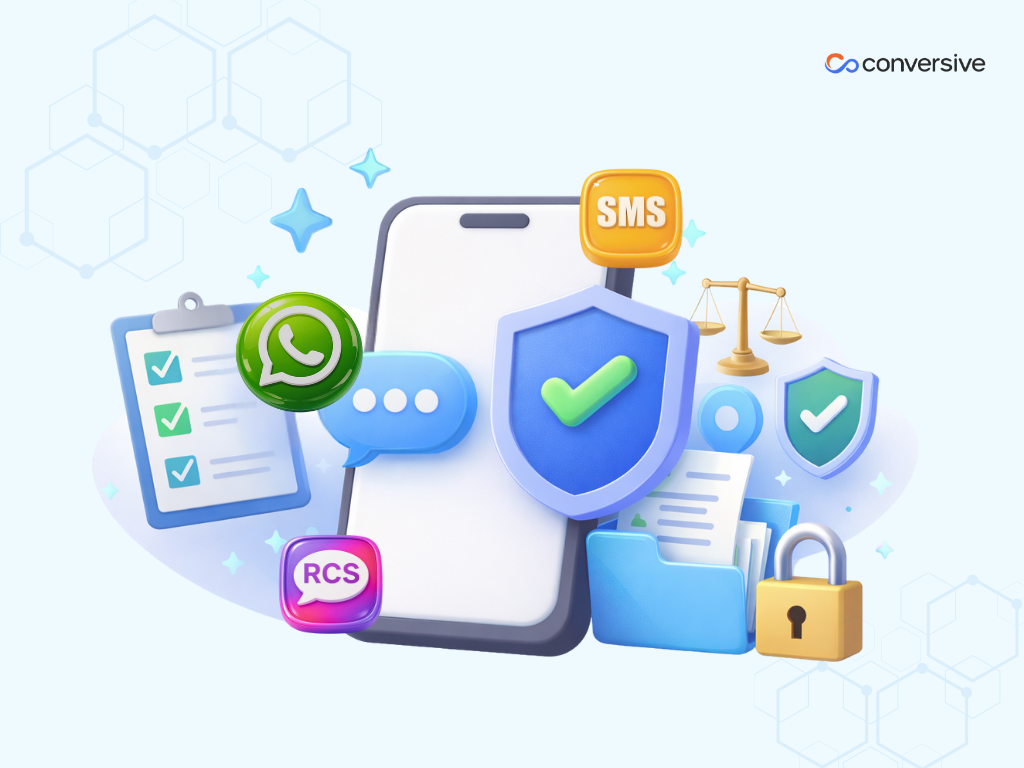
.png)
What Is GDPR? Why Does GDPR‑Compliant Messaging Matters for Your Business?
Sending messages to EU customers? Conversive helps you stay compliant with GDPR using secure opt-ins, encryption, audit logs, and privacy-first workflows.
GDPR‑compliant messaging means your customer communications meet the European Union’s strict data protection standards. GDPR (the General Data Protection Regulation) defines how businesses must collect, store, process, and use personal data when communicating with individuals in the EU.
For any business that sends messages via SMS, WhatsApp, email, or in‑app notifications and handles EU residents’ personal information, GDPR compliance is mandatory. This includes names, phone numbers, message content, behavioral data, and any identifiers tied to an individual.
Ignoring GDPR isn’t an option. Non‑compliance can lead to:
- Massive financial penalties: Up to €20 million or 4% of global annual turnover (whichever is higher).
- Legal exposure: Enforceable investigations by data protection authorities.
- Reputational damage: Loss of customer trust and brand credibility.
- Operational setbacks: Forced audits, work stoppages, or restrictions on data use.
This article breaks down what GDPR‑compliant messaging really involves, who must comply, the core requirements you must meet, and how Conversive enables secure, privacy‑first conversations across channels.
Who Needs to Comply with GDPR in Messaging?
GDPR applies to any organization that collects, stores, or uses personal data of individuals in the European Union regardless of where that organization is based. This includes companies located outside the EU if they:
- Offer products or services to people in the EU
- Track or communicate with EU users (e.g., through SMS, WhatsApp, email, or other channels)
While GDPR is industry-agnostic, certain sectors are particularly impacted due to their reliance on personal data and frequent messaging:
- Healthcare: Patient communication, appointment reminders, telehealth follow-ups
- Education: Admissions, results, student engagement
- Financial Services: Loan application updates, fraud alerts, transactional messages
- Real Estate: Property notifications, client updates, legal documents
- E-commerce & Retail: Cart reminders, delivery updates, loyalty messages
GDPR doesn’t only apply to email marketing or web forms. It extends to every messaging channel where personal data is exchanged or processed, including:
- SMS and MMS
- WhatsApp Business and other messaging apps
- Voice AI interactions (if recorded or logged)
- In-app or web chat with user tracking
Even if your business is just a messaging service provider (e.g., platform or CRM integrator), you are considered a data processor under GDPR and must comply fully including signing a Data Processing Agreement (DPA) with your clients.
In short, if you send messages to EU residents or handle personal data in those conversations, GDPR applies.
What Are the Core GDPR Requirements for Business Messaging?
When businesses engage with EU citizens through messaging via SMS, WhatsApp, email, or any other channel, they are subject to the General Data Protection Regulation (GDPR).
Here are the key GDPR requirements that apply specifically to business messaging:
1. Consent and Lawful Basis for Contact
Before sending any message that involves personal data, businesses must have a lawful basis for doing so. Most commonly, they are expected to have explicit consent.
- Consent must be freely given, specific, informed, and unambiguous.
- Silent opt-ins, pre-checked boxes, or vague statements don’t meet the standard.
- Double opt-in (where the recipient confirms via a follow-up message) is often recommended for added clarity.
2. Data Minimization and Purpose Limitation
Messaging must be limited to what is necessary and aligned with the purpose for which consent was originally obtained.
- Only the data required for the intended communication should be collected and stored.
- Messages should not include excessive personal or sensitive details, especially if transmitted over unsecured channels like standard SMS.
3. Right to Access, Portability, and Erasure
Individuals have the right to:
- Request a copy of all personal data held by your business (including message history).
- Request the deletion of that data (“right to be forgotten”).
- Ask for their data to be transferred to another provider in a portable format.
Your messaging system must support these requests within the one-month response window GDPR requires.
4. Security and Data Integrity
All personal data used in messaging must be protected using technical and organizational measures that prevent unauthorized access or disclosure.
- Encryption in transit and at rest is strongly encouraged, even required, for high-sensitivity data.
- Role-based access controls help restrict sensitive data to only those who need it.
5. Breach Notification Preparedness
In case of a data breach such as unauthorized access to message history or exposed opt-in logs, GDPR requires:
- Notification to the relevant supervisory authority within 72 hours.
- Communication to affected individuals if the risk is high to their rights and freedoms.
Preparedness here means knowing where data lives, how it flows, and who has access.
6. Auditability and Documentation
GDPR requires that businesses not only follow privacy rules but can prove it.
- Maintain consent logs, message delivery records, and access histories.
- Store Data Processing Agreements (DPAs) with any vendor (like messaging providers) that handles EU personal data on your behalf.
How Conversive Helps You Stay GDPR-Compliant
Conversive is designed to meet GDPR requirements with integrated privacy, consent, and audit capabilities across all messaging workflows. Every feature is built to support responsible data handling from the moment a customer opts in, to how messages are stored, accessed, and eventually erased.
This section outlines how Conversive supports GDPR compliance at each critical touchpoint:-
i) Conversive Enables Secure Opt-In Flows for SMS and WhatsApp
Obtaining valid, documented consent is a foundational requirement under GDPR. Conversive ensures this step is seamless and verifiable:
a) Visual Opt-In Forms
Conversive allows businesses to design and deploy branded opt-in forms for SMS, WhatsApp, or email, which can be hosted on landing pages or embedded in CRM workflows. These forms capture clear, unambiguous consent in line with GDPR expectations.
b) CRM-Integrated Consent Capture
When someone opts in, that consent is automatically logged against the corresponding CRM record (Lead, Contact, or Custom Module). This creates a single source of truth without requiring manual updates or exports.
c) Double Opt-In Workflows
For additional verification, Conversive supports optional double opt-in. Once a user submits their details, they receive a confirmation message to validate their consent before communication begins ensuring higher confidence and traceability.
d) Consent Timestamping and Source Tracking
Every opt-in is timestamped and tagged with its source (e.g., form name, channel), enabling full transparency for audits or user inquiries.
ii) Conversive Enforces Privacy by Design
Conversive is built around the principle of privacy by design, ensuring that customer data is protected at every stage of the messaging lifecycle:
a) End-to-End Encryption
All data, whether in transit or at rest, is secured using RSA-2048 encryption. This protects sensitive personal data from unauthorized access and meets GDPR’s data security standards.
b) Role-Based Access Controls
Administrators can define granular permissions, limiting access to PHI, personal details, or sensitive message logs based on roles or departments. This minimizes risk from overexposure.
c) Field Masking
Sensitive fields (e.g., medical or financial attributes) can be masked within Conversive’s interface. This means agents can perform their tasks without viewing unnecessary personal data.
d) Consent-Tagged Templates
Message templates can be tagged with specific consent categories (e.g., marketing, support, billing). Conversive blocks or warns users if they attempt to use a template outside its approved context helping avoid accidental violations.
iii) Conversive Supports Data Subject Rights (DSARs)
Under GDPR, individuals have rights over their personal data including the right to access, correct, delete, or export it. Conversive makes it simple to comply with these requests:
a) Message History Retrieval
Support teams can quickly retrieve a user’s full message history spanning SMS, WhatsApp, and more from the CRM or messaging interface, making data access requests easy to fulfill.
b) Data Deletion Tools
With one action, all messages and metadata related to a contact can be securely deleted, helping you fulfill “right to be forgotten” requests within legal timeframes.
c) Portable Exports
Conversive supports exporting personal message history in a structured, machine-readable format (e.g., CSV or JSON), enabling compliance with GDPR’s data portability provisions.
iv) Conversive Provides Real-Time Audit Trails
Conversive gives businesses full visibility into messaging operations and consent activity, ensuring you can demonstrate compliance at any point:
a) Consent Logs and Status
Every contact record includes real-time status of opt-in/opt-out, consent source, and timestamp history available to both agents and compliance teams.
b) Message Delivery and Interaction History
From message sent/delivery status to user replies and opt-out confirmations, everything is logged and accessible for audits.
c) Access Logging
Admins can view which users accessed message histories, templates, or sensitive contact data, creating accountability across teams.
v) Conversive Offers Legal and Policy Support
Beyond product features, Conversive provides documentation and collaboration to ensure your messaging policies align with GDPR:
a) GDPR-Aligned Data Processing Agreement (DPA)
Conversive provides a standard DPA that outlines roles, responsibilities, and safeguards in accordance with GDPR. This is available for all customers using messaging services involving EU resident data.
b) Custom Policy Support
For organizations with specific legal requirements (e.g., healthcare, financial services), Conversive works with internal or external legal counsel to review and adjust terms where needed.
Risks of Using Non-Compliant Messaging Tools
Using messaging tools that aren’t designed with GDPR in mind exposes businesses to significant risks, both legal and operational. While many platforms can deliver messages, not all are built to handle the privacy obligations that come with customer communication in regulated environments.
1. Legal and Financial Penalties
Under GDPR, violations related to consent, data mishandling, or improper access can trigger severe penalties:
- Fines can reach up to €20 million or 4% of annual global turnover, whichever is higher.
- Even unintentional lapses such as sending a message to someone who never opted in can result in formal investigations and fines.
2. Customer Trust and Reputational Damage
Data breaches or privacy violations erode customer confidence, especially in industries like healthcare, finance, or education where confidentiality is critical.
- A single complaint can lead to audits and increased scrutiny.
- Public exposure of non-compliance may discourage existing customers and affect future contracts.
3. No Proof = No Defense
If you cannot show consent logs, message histories, or evidence of lawful processing, you're automatically at risk even if your intentions were aligned with GDPR.
- Most non-compliant tools lack proper audit logs, opt-in traceability, or data subject request workflows.
- This makes it difficult to defend against even minor allegations of improper data handling.
4. Increased Operational Burden
Without a compliant system in place, fulfilling GDPR requests (like deletion or data access) becomes manual, inconsistent, and error-prone.
- Teams waste hours digging through fragmented systems to respond to one DSAR.
- Missed response deadlines can compound legal risk.
5. No Safety Net for Messaging Content
Unregulated tools don’t check if message templates carry personally identifiable information (PII), putting businesses at risk of accidentally exposing PHI, financial data, or sensitive identifiers.
GDPR Compliance Checklist for Business Messaging
To ensure every conversation stays compliant, Conversive includes built-in controls, processes, and safeguards aligned with GDPR.
Here’s a practical GDPR-compliance checklist for business messaging:
i) Active Opt-In Before First Message
Conversive supports structured opt-in flows for SMS, WhatsApp, and other channels. Users cannot be contacted until their consent is explicitly captured and logged, ensuring a lawful basis for outreach.
ii) Easy STOP/Opt-Out Handling
Every messaging flow includes automated STOP or opt-out handling. Customers can withdraw consent at any time, and their preferences are immediately enforced across future messaging.
iii) DPA Signed and Available
Conversive offers a GDPR-ready Data Processing Agreement (DPA), which can be customized and signed to satisfy your legal and procurement requirements.
iv) All Data Encrypted in Transit and at Rest
From message content to logs and consent records, Conversive encrypts all customer data using industry-standard protocols (RSA-2048 and AES-256). This protects data during transmission and storage.
v) Messaging History Accessible for DSAR
Conversive keeps a complete message history with timestamped logs, allowing businesses to fulfill data subject access requests (DSARs) quickly and accurately.
vi) No PII in Unprotected Templates
Message templates are consent-tagged and can be reviewed for PII exposure before sending. This ensures personal data isn’t inadvertently sent through unsecured channels.
vii) Role-Based Access and Controls
Admin-defined roles restrict who can view, send, or export data. Access controls ensure that only authorized team members interact with sensitive messaging workflows.
Why Businesses Choose Conversive for GDPR-Compliant Messaging
For teams that operate in privacy-sensitive sectors like healthcare, finance, education, or government, Conversive offers the balance of control, automation, and compliance that modern messaging demands.
The platform is purpose-built for secure, lawful engagement:-
1. Built for Privacy-First Industries
Conversive was designed from day one to serve trust-critical industries. It supports consent workflows, avoids unnecessary exposure of personal data, and embeds safeguards required by regulations like GDPR, HIPAA, and more.
2. CRM-Native, Not CRM-Limited
Conversive integrates deeply with CRMs like Salesforce and Zoho but it’s not locked to them. Any CRM or system that holds customer records can be securely connected, allowing GDPR-compliant conversations to remain grounded in real-time customer context.
3. Templates and Journeys That Minimize PII Risk
From appointment reminders to policy updates, Conversive helps you build message journeys that avoid transmitting sensitive data. Templates can be tagged for consent types, checked for compliance, and automated with full logging.
4. One Unified Dashboard for All Channels
SMS, WhatsApp, RCS, and voice interactions are all managed through a single dashboard, so compliance and consent preferences carry across every touchpoint. You can avoid redundancy, reduce risk, and simplify audit tracking.
5. Built for Global Compliance
Conversive isn’t just built for GDPR, it supports a growing matrix of regional rules. Whether you’re navigating India’s DLT framework, HIPAA protections in the U.S., or emerging data laws in other regions, Conversive keeps your messaging aligned with the standards that matter.
Book a demo to see how Conversive can make GDPR compliance effortless for your team.
Frequently Asked Questions
What is GDPR-compliant messaging?
GDPR-compliant messaging means that all personal data involved in customer communication across SMS, WhatsApp, email, or voice is handled according to the General Data Protection Regulation (GDPR). That includes obtaining consent, securing data, honoring subject access requests, and documenting compliance.
Do I need to comply with GDPR if I’m not based in the EU?
Yes. GDPR applies to any business that communicates with, stores, or processes the personal data of EU residents regardless of where the business is headquartered. If you engage EU citizens through messaging, compliance is required.
How does Conversive support GDPR compliance?
Conversive enables compliant customer messaging through secure opt-in collection, encrypted message delivery, audit trails, and data subject rights management. The platform supports retrieval and deletion requests, restricts access to sensitive data, and provides a GDPR-ready Data Processing Agreement (DPA).
Can I use WhatsApp under GDPR?
Yes, but only if it’s used through a compliant Business Messaging Platform like Conversive. You'll need proper opt-in, secure data handling, and documented consent for WhatsApp to be lawful under GDPR.
Is Conversive suitable for other regulations like HIPAA or India DLT?
Absolutely. Conversive is designed for multi-jurisdictional compliance. It helps healthcare organizations meet HIPAA standards in the U.S., supports India’s DLT registration and scrubbing rules, and aligns with global data protection laws in a single platform.


.png)

Explore More