.png)
The Complete Guide to Business Messaging Compliance in 2026
Stay compliant while scaling message engagement. This guide breaks down best practices for consent capture, opt-outs, timing regulations, SHAFT content rules, and geo‑specific compliance across SMS, WhatsApp, and RCS.
SMS sees open rates as high as 98%.
Nearly 90% of messages are read within three minutes.
And when asked clearly, over 70% of users opt in to receive updates.
This makes channels like SMS, WhatsApp, and RCS invaluable for businesses trying to reach customers quickly and reliably. But with that power comes regulation. Messaging is governed by a complex web of:
- Telecom carrier rules (e.g., 10DLC, CTIA)
- Data privacy laws (GDPR, CCPA, CASL)
- Compliance frameworks (HIPAA, TCPA)
- Platform-specific policies (e.g., WhatsApp Business API rules)
Violating these regulations doesn’t just reduce deliverability, it can result in message blocking, fines, or permanent blacklisting.
If your business relies on messaging for outreach, support, or operations, compliance isn’t optional, it’s foundational. In the next section, we’ll break down the six core practices every team should follow to stay compliant while scaling their messaging.
To stay compliant across SMS, WhatsApp, and other messaging platforms, businesses must follow strict rules, not just to avoid penalties, but to ensure deliverability and customer trust.
Here are 6 essential practices:
#1. Always Obtain Express Written Consent
When it comes to messaging compliance, nothing matters more than permission. Before you ever send an SMS, WhatsApp message, RCS notification, or even a WhatsApp Business template, you must have clear, documented consent from the recipient. This is not optional, it’s required by laws like TCPA (in the U.S.), GDPR (in the EU), and CASL (in Canada).
Express written consent means the customer has affirmatively agreed to receive messages from your business. It can’t be pre‑checked boxes, buried language, or implied from a purchase.
Examples of compliant opt‑in mechanisms include:
- A website form where the user checks a box consenting to receive SMS or WhatsApp alerts.
- An in‑app prompt asking the user to agree to message communications.
- A keyword opt‑in (e.g., “Text START to 12345”) that triggers a consent capture.
Without expressed consent:
- Your messages can be treated as spam, triggering carrier filters.
- You can lose message deliverability entirely.
- You risk hefty fines. Under TCPA this can be up to $1,500 per unsolicited message.
- In the EU, GDPR fines can reach millions if you process personal contact data without lawful basis.
For example, a clinic wants to send appointment reminders via SMS. They collect phone numbers at check‑in, but do not explicitly ask for SMS permission. Later, a patient complains about unwanted reminders. Because consent was never clearly captured, the clinic risks regulatory complaints and may have to stop messaging entirely, even for legitimate reminders.
#2. Send a Clear Confirmation Message
Once a customer consents, the very first message you send should be a confirmation that sets expectations. This message is a compliance checkpoint.
A confirmation message should clearly state:
- Who you are: Your business or brand name
- What kind of messages they’ll receive: Alerts, reminders, promotions, etc.
- Message frequency: For example, “Up to 4 messages per month”
- Message/data rates may apply
- Easy opt‑out instructions: Typically “Reply STOP to unsubscribe”
This serves multiple purposes:
- It reinforces transparency with the customer.
- It creates a documented baseline for what was agreed to.
- It protects your messaging program during audits or disputes.
Let’s say, a credit union signs up members for SMS fraud alerts. After the member opts in at a branch kiosk, the first automated message from your system reads:
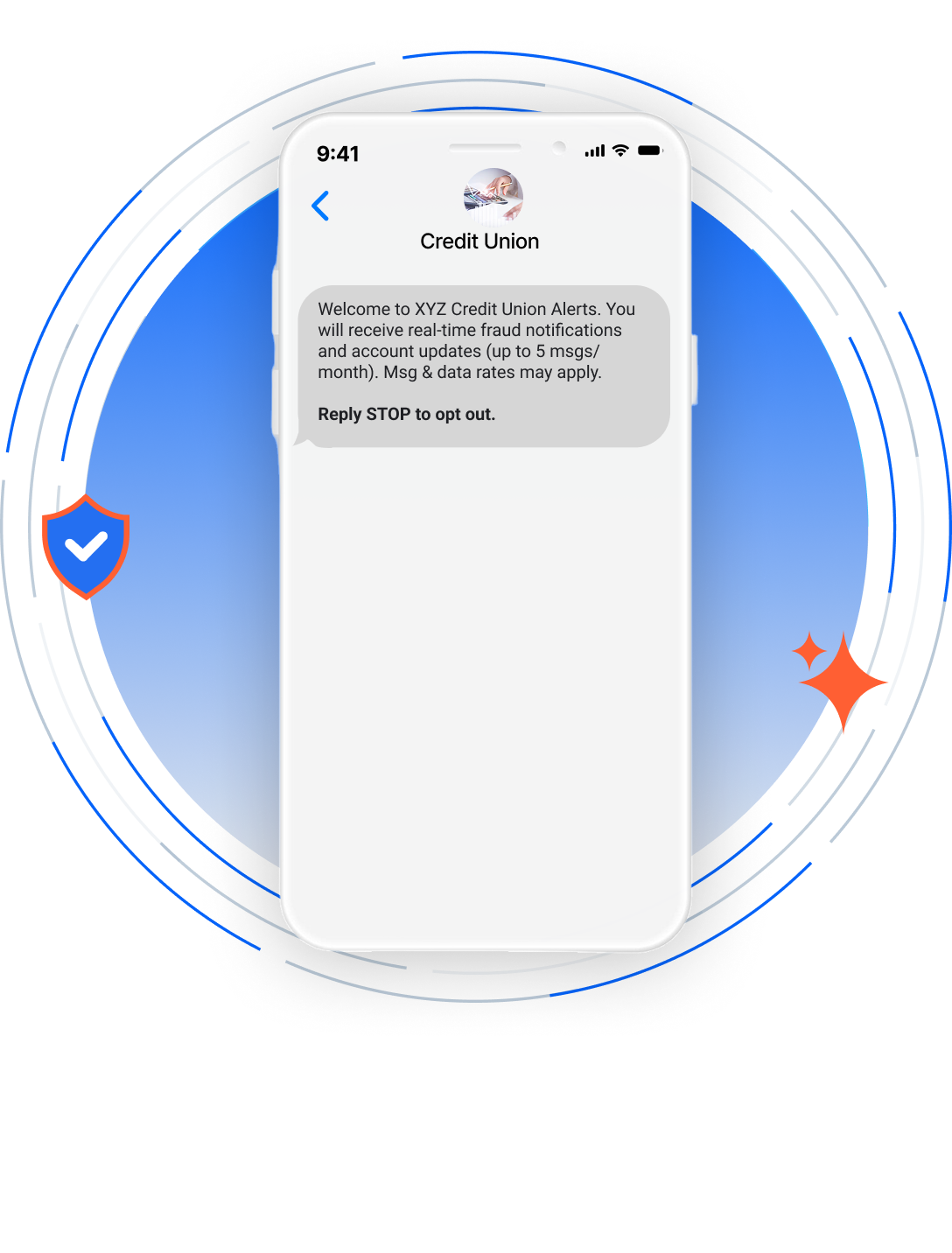
This confirmation gives the member clarity and creates a logged record that the consent was understood. If the member later files a complaint, your compliance logs clearly show that they opted in and received the confirmation, significantly reducing risk.
#3. Use Fully Compliant CTAs for Opt‑Ins
Your opt‑in call‑to‑action (CTA) is where consent begins. It’s also where most compliance mistakes happen because most marketers write CTAs for conversions, not legal clarity.
A compliant CTA must communicate clearly and fully:
- What content the subscriber will receive (e.g., appointment reminders, promotional offers, updates)
- Frequency (how often messages will be sent)
- Messaging charges (e.g., “Msg&data rates may apply”)
- Terms & conditions (linked if applicable)
- Support contact information
- Opt‑out instructions
Here’s a compliant CTA example:-
![Sign up for appointment reminders via SMS. Up to 4 msgs/month. Msg&data rates may apply. Reply STOP to opt out. Terms: [link]. Support: (555) 123‑4567.](https://cdn.prod.website-files.com/677fc3cb9471e660b4e7a6f4/6960c5aa2b3d322a7a657227_2.png)
CTAs that fail to disclose these elements can be considered violations under:
- TCPA (U.S.)
- GDPR (EU)
- CASL (Canada)
- State or provincial privacy laws
If regulators or carriers audit your program, they will inspect not only whether consent was captured but how it was presented.
For example, if a university wants to send deadline reminders and alerts to students. A generic CTA like “Sign up for SMS alerts!” does not meet compliance requirements because it doesn’t disclose frequency, types of messages, or opt‑out info.
In contrast, a compliant CTA such as this clearly tells students what to expect and protects the institution.:
![Get class deadlines and campus alerts via SMS, up to 8 msgs/semester. Msg&data rates may apply. Reply STOP to unsubscribe. Privacy: [link].](https://cdn.prod.website-files.com/677fc3cb9471e660b4e7a6f4/6960c5e5393bb681256be184_3.png)
#4. Avoid SHAFT Content at All Costs
In messaging compliance, the term SHAFT refers to Sex, Hate, Alcohol, Firearms, and Tobacco. These content categories are strictly prohibited on most messaging platforms and are heavily filtered or outright blocked by carriers and aggregators.
Even if your business operates in one of these industries, you can’t just start messaging customers without advanced vetting and alternate compliance paths.
Carriers and regulators treat SHAFT categories as high-risk because they:
- Are heavily regulated by law (e.g., tobacco and alcohol sales to minors)
- May provoke consumer complaints or spam reports
- Pose reputational and legal risks to telecom infrastructure
Here’s how SHAFT enforcement looks in practice:-
- Keywords or links related to SHAFT topics are automatically scanned.
- If detected, your number may be flagged or immediately blacklisted.
- Repeat violations can lead to 10DLC deregistration or permanent carrier blocks.
Let’s say a real estate agent also promotes a wine-of-the-month club on the side and wants to message subscribers about special offers. If that wine promo goes out via SMS without prior carrier vetting, it could get blocked automatically.
Instead, the business must apply for carrier vetting for alcohol-related content and go through special compliance review. Even then, only informational content (not marketing) may be permitted.
#5. Respect Timing Rules for Message Delivery
Even if your content is perfectly legal, sending it at the wrong time can still break compliance rules. Many regulations, including TCPA in the U.S., explicitly limit the hours when businesses can message customers.
Here are general timing rules based on geolocations:-
- U.S. TCPA: 8:00 a.m. to 9:00 p.m. (local time of the recipient)
- Canada CASL: No explicit hours, but anti-spam and abuse prevention still apply
- EU GDPR: Indirect timing via “reasonable use” and privacy expectations
Sending messages outside of these windows can lead to:
- Spam complaints
- Opt-outs
- Carrier penalties
- Loss of trust from recipients
Let’s say, a wealth management firm uses SMS to remind clients about portfolio updates. Their CRM sends a batch of updates at 6 a.m. which means some clients on the West Coast receive messages at 3 a.m.
Even though the message content is valid, the timing is a compliance and customer service failure. Clients may opt out or file complaints, jeopardizing the firm’s outreach program.
#6. Be Fully Opt-Out Compliant
It’s not enough to let users opt out, you need to make it frictionless, enforceable, and documented.
Requirements for a compliant opt-out process:-
- Clear language: “Reply STOP to unsubscribe”
- Real-time action: Unsubscribes must take effect immediately
- Confirmation: The system must confirm opt-out with a message like:
“You have successfully unsubscribed. No further messages will be sent.” - Ongoing reminders: For recurring messages, include opt-out instructions every 30 days
For example if a tutoring center sends weekly study tips via SMS. One parent replies “stop,” but the system doesn’t process it because it’s not capitalized or because the platform only accepts “UNSUBSCRIBE.” The parent receives another message the following week and files a complaint with the carrier.
This is a compliance failure and an avoidable one.
Country‑Specific Messaging Rules Matter
Messaging compliance is not uniform across the world. Each major region or country has its own legal and carrier requirements that govern when, how, and what you can message. If you treat compliance as a single global rulebook, you risk delivery failures, regulatory penalties, and customer complaints.
Below are the most important rules for key markets where many global businesses operate.
i) United States: TCPA, CTIA, and 10DLC Requirements
In the U.S., messaging compliance is shaped by a combination of federal law and industry standards:
The Telephone Consumer Protection Act (TCPA) requires that you collect express written consent before sending any marketing or promotional SMS messages. TCPA also governs autodialing and restricts the times of day you may send messages.
Carrier consortium guidelines from CTIA provide additional requirements that carriers enforce, such as required language in opt‑in and opt‑out messaging, and specific content restrictions.
Additionally, for SMS sent from long codes, businesses must register with 10DLC (10‑digit long code) systems. If you do not formally register your brand and campaign, carriers will block or heavily filter your traffic.
Because these rules layer on top of one another, U.S. compliance means handling consent, opt‑outs, timing windows, registration, and carrier guidelines together, not in isolation.
ii) European Union: GDPR and Consent Intensity
In the European Union, the key regulation is the General Data Protection Regulation (GDPR), which governs all personal data. Phone numbers count as personal data, and how you process them including when you message someone must meet GDPR standards.
GDPR requires clear, unambiguous consent for messaging, along with the ability for customers to access, correct, or delete their data. You must also provide records of consent upon request and minimize how long personal data is stored.
This means you can’t simply rely on other legal bases like legitimate interest, you must document consent for messaging and be prepared to respond to data subject requests tied to those message records.
iii) Canada: CASL’s Strict Consent Framework
Canada’s Canada Anti‑Spam Legislation (CASL) is among the toughest messaging laws in the world. CASL requires express consent before sending any commercial electronic message including SMS, WhatsApp broadcasts, or email.
Unlike some other laws, CASL also requires that every message clearly identifies the sender and provides an unambiguous unsubscribe mechanism that works without additional authentication or forms.
Failure to comply with CASL can lead to steep fines and blocked messaging pathways, making it essential for global brands to treat Canadian consent as a priority rather than an afterthought.
iv) India: DLT and Telecom Registration Rules
In India, messaging compliance is governed by telecom regulators using a Distributed Ledger Technology (DLT) registry. All businesses that send SMS must register their use cases, message templates, and headers before sending traffic. Carriers enforce these registration rules, and unregistered messages are routinely blocked.
While India does not have a GDPR‑style privacy law yet, the DLT requirements function as a compliance backbone for SMS in the market. They ensure that messages are template‑bound, traceable, and linked to a registered brand identity.
v) Brazil: LGPD and Messaging Privacy
Brazil’s Lei Geral de Proteção de Dados (LGPD) resembles the GDPR with respect to personal data protections, including phone numbers used for messaging.
Under LGPD, you must justify your legal basis for each message (such as consent), honor data subject rights, and implement adequate security controls. Many organizations that message customers in Brazil treat LGPD as equal to GDPR in terms of privacy expectations and data governance.
Why This Matters for Global Teams
If your business sends messages across different countries, you cannot rely on a single compliance approach. For example:
- A U.S. TCPA‑compliant opt‑in may not satisfy GDPR’s information requirements.
- Canada’s CASL opt‑in must explicitly name the sender in ways other laws may not require.
- India’s DLT rules mandate registered templates before a message is even allowed onto the network.
Conversive can enforce region‑specific consent collection, message templates, delivery windows, and audit logging based on local rules, so you don’t have to manage each case manually.
How Conversive Supports End-to-End Messaging Compliance
Instead of requiring manual configuration or legal guesswork, Conversive bakes compliance into every layer of its platform, from message capture to delivery to audit.
Here are key capabilities that sets Conversive apart:-
i) Pre-configured opt-in/opt-out flows
Conversive supports compliant consent collection across SMS, WhatsApp, and RCS. This includes web-based, in-app, and keyword-triggered opt-ins with proper audit tagging.
ii) Consent capture baked into every journey
Whether you’re sending a reminder, initiating a campaign, or replying to an inbound query, consent capture is seamlessly woven into the workflow ensuring you never message a customer who hasn’t opted in.
iii) Audit trails for every message and interaction
Every message, reply, and opt-out is logged with time stamps, user ID, and contact details. This supports legal audits and DSARs (Data Subject Access Requests) under laws like GDPR.
iv) Compliance toolkits for 10DLC, WhatsApp API, and more
Conversive includes guided flows and automated registration for U.S. 10DLC compliance, WhatsApp Business API templates, and telecom-specific rules.
v) Quiet hours and frequency controls
Define region-based sending windows (e.g., 8 a.m. to 9 p.m. local time) and set message frequency limits to prevent over-messaging or accidental spam flags.
vi) Geo-specific policy enforcement
Whether you're targeting customers in California, Germany, or Ontario, Conversive applies local compliance logic automatically so you stay aligned with TCPA, GDPR, CCPA, CASL, and more.
vii) Redaction and retention features
For industries that require strict data governance (healthcare, finance, education), Conversive enables role-based access, automatic redaction, and customizable data retention windows.
Why Businesses Choose Conversive for Messaging Compliance
Organizations in regulated sectors like healthcare, education, government, finance, and real estate turn to Conversive because it removes the guesswork and risk from high-volume messaging. Instead of stitching together separate tools for SMS, WhatsApp, RCS, and compliance logging, Conversive provides a unified platform that prioritizes data protection, consent, and message deliverability by default.
Here’s what sets Conversive apart:
- Conversive centralizes opt-in management, audit logs, redaction policies, and legal documentation across all supported channels.
- From HIPAA to GDPR to CCPA, Conversive is engineered for sensitive environments. That includes native compliance features and integrations with sector-specific systems like EHRs, CRMs, and service desks.
- Quiet hours, frequency limits, keyword scanning, and template approval help your team avoid accidental violations, even when running multiple campaigns.
- Marketing, admissions, or patient engagement teams can use Conversive without developer dependencies. Templates, journeys, and opt-in flows are customizable through a visual interface with compliance already structured underneath.
- Whether you have 3 users or 300, Conversive supports scalable, permission-controlled compliance across teams, departments, and locations.
Book a demo to see how Conversive simplifies global messaging compliance
Frequently Asked Questions
What are the risks of messaging customers without consent?
Businesses that send messages without explicit permission risk severe penalties. For example, in the U.S., TCPA violations can lead to fines of up to $1,500 per unauthorized message. Beyond regulatory fines, carriers may block or throttle your messages, and customers may lose trust in your brand particularly in industries like healthcare or finance where privacy expectations are high.
How often should customers be reminded about opt-out options?
For ongoing campaigns, best practice is to include opt-out instructions at least once every 30 days, or in every recurring message thread. Platforms like Conversive automate this by including opt-out reminders within templates and periodically surfacing compliance alerts in your dashboard.
Do messaging rules differ by country?
Yes. Each region enforces its own regulations:
- U.S.: TCPA, CTIA guidelines, and 10DLC registration.
- EU: GDPR requirements for explicit consent, auditability, and deletion rights.
- Canada: CASL mandates express consent and transparency.
Global companies need a platform (like Conversive) that enforces geo-specific rules automatically ensuring the right rules apply in the right places.
Are WhatsApp Business messages subject to the same regulations as SMS?
They are subject to different technical approval flows, but the legal burden is similar. For example, under GDPR, WhatsApp messages must still have auditable consent, data minimization, and clear opt-out workflows. Conversive handles these regulatory overlaps through channel-specific compliance settings and template governance.
Can one opt-in cover both transactional and promotional messages?
No. Compliance standards require distinct opt-ins for different message categories. If a patient opts in to receive appointment reminders, that does not permit marketing follow-ups unless separately authorized. Conversive supports multi-layered consent capture, clearly separating transactional and promotional consent types.


.png)

Explore More