.png)
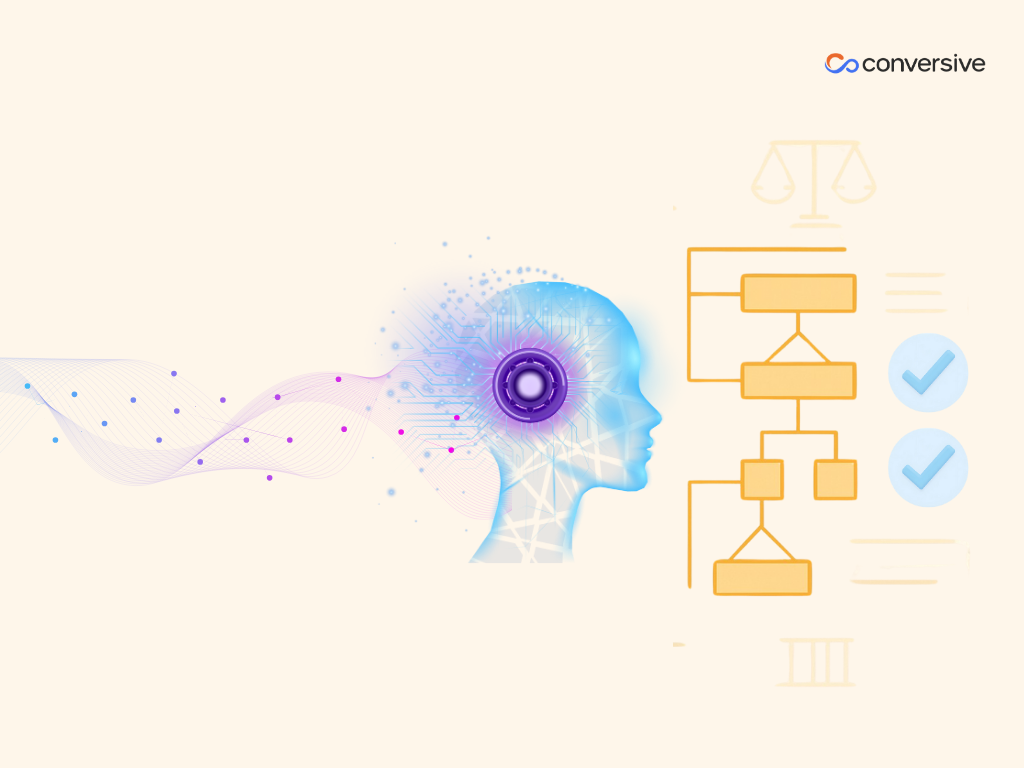
Why Hybrid AI Is the Future of Enterprise Automation?
Learn how Hybrid AI combines rules and machine learning to deliver scalable, compliant automation for enterprises in finance, healthcare, and beyond.
If you work in a regulated, high-stakes industry, you’ve likely seen the limits of machine learning when deployed on its own.
Maybe a chatbot hallucinated.
Maybe a model made a decision you couldn’t explain to a compliance officer.
Or maybe you’ve hesitated to automate workflows because you just didn’t trust the system to act responsibly.
And this is why so many of the enterprise teams we speak with are now leaning into Hybrid AI.
Hybrid AI combines two historically separate approaches:
- Symbolic reasoning (the world of rules, logic, and
- Structure) and machine learning (pattern recognition, adaptability, and prediction).
Together, they form a new kind of system that can automate intelligently but also explain its decisions, enforce policies, and respect boundaries.
At Conversive, we see Hybrid AI as the foundation for enterprise-grade automation which is scalable for real workloads, but safe and transparent for industries like finance, education, healthcare, real estate, and legal.
In this article, we’ll walk you through what Hybrid AI is, why it’s emerging as the preferred path for enterprise automation, and how we’re building Conversive around this architecture to serve compliance-first, high-touch environments.
What is Hybrid AI?
Hybrid AI is an approach to artificial intelligence that fuses two distinct paradigms, symbolic reasoning (rules-based logic) and machine learning (pattern recognition through data). Both of them have their own strengths and limitations. But together, they create systems that are adaptable, explainable, and safe which is exactly what enterprise environments demand.
Traditional AI architectures rely solely on machine learning, but Hybrid AI systems can reason through decisions and explain how they got there. They can personalize messages, automate tasks, or flag anomalies while adhering to guardrails that ensure trust and accountability..
i) Hybrid AI Uses Symbolic Rules for Structure and Machine Learning for Pattern Detection
Machine learning is excellent at recognizing patterns such as identifying sentiment, predicting buyer intent, or classifying support requests. But on its own, it lacks control. It might generate a recommendation, but you don’t always know why it did.
Symbolic AI solves this problem.
With predefined rules, decision trees, or knowledge graphs, symbolic reasoning ensures that every action follows a known logic. In a hybrid system, ML can detect the signal and symbolic logic decides what’s allowed to happen next.
This combination means you get smarter automation and a safety net which is critical in industries where decisions must be defensible, not just accurate.
ii) Hybrid AI Systems Process, Validate, and Learn from Data in Real Time
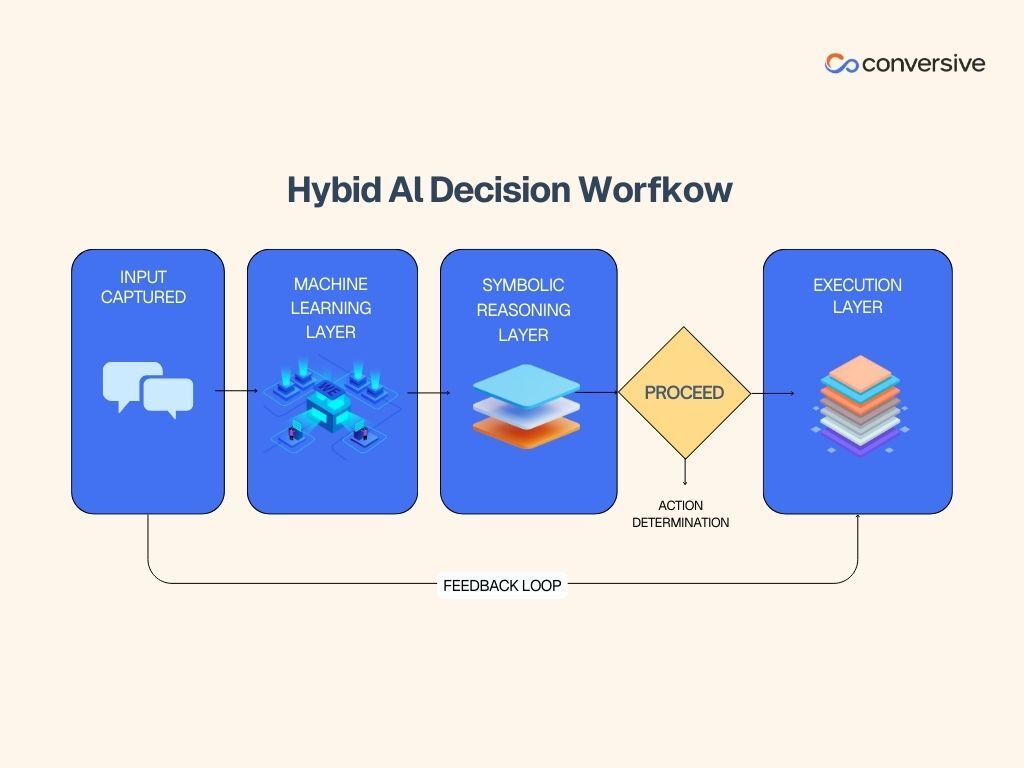
A typical hybrid pipeline works like this:
- Input comes in (a message, form, or signal).
- Machine learning analyzes it to predict intent or extract meaning.
- Then the symbolic layer validates it by checking business rules, regulatory constraints, or process flows.
- If the output passes, the system acts. If not, it flags for review, suggests alternatives, or adapts the next response.
This creates a feedback loop where data, logic, and human oversight work in coherence continuously improving the system while keeping it grounded.
Why Enterprises Are Turning to Hybrid AI
Did you ever delay an AI rollout because your legal team had concerns, or because your users couldn’t trust the results? We hear this all the time in conversations with enterprise customers, especially in finance, healthcare, and legal.
They often say, “We need AI that performs, but we also need to explain it, audit it, and stay in control.”
That’s exactly where Hybrid AI stands out.
Hybrid AI Enables Compliance, Auditability, and Human Oversight
With Hybrid AI, every decision is both informed by data and grounded in logic. You can trace exactly why a message was sent, what rule allowed it, and how the system interpreted the input. That level of auditability is critical when you're operating in regulated environments like HIPAA, GDPR, or financial disclosures.
Hybrid systems also support human-in-the-loop controls. If an output falls outside of bounds, it’s flagged, not pushed through blindly. That means automation doesn’t override your policies; it reinforces them.
At Conversive, we design our agents to keep you in the loop where it matters most — without making you micromanage every interaction.
Traditional AI Systems Struggle with Hallucinations, Bias, and Lack of Reasoning
Purely ML-driven systems can be unpredictable. They hallucinate. They reflect bias from their training data. And most importantly, they often make decisions that no one, not even your engineering team can explain.
That’s fine if you’re building a consumer chatbot for low-risk tasks. But if you’re automating compliance-sensitive workflows, or interacting with patients, students, or financial clients, that lack of reasoning becomes a dealbreaker.
Hybrid AI corrects for these weaknesses by introducing guardrails. You still get the learning benefits of machine learning but every decision passes through logic that you can define, track, and improve.
Enterprise Use Cases of Hybrid AI
Hybrid AI is finding use-cases in the most risk-sensitive sectors such as finance, healthcare, and customer support.
Below are real use cases where hybrid AI is operational, scalable, and delivering ROI:-
i) Education
Universities and education providers increasingly use AI to manage admissions, student services, and academic advising. But these processes often require both personalization and adherence to institutional policies.
Hybrid AI can analyze a prospective student’s profile, their academic background, engagement history, or stated interests, and match them with relevant programs or scholarships. Before sending recommendations, the system cross-checks eligibility criteria, enrollment caps, or advisor-defined logic to ensure accuracy and fairness.
ii) Finance
Imagine you're a compliance officer reviewing thousands of transactions per day. A traditional ML model might flag unusual patterns including large withdrawals, suspicious transfers, or deviations from typical behavior.
But how do you know which ones really matter?
With Hybrid AI, machine learning surfaces the anomalies, while symbolic logic cross-checks them against regulatory rules, thresholds, or prior actions. This drastically reduces false positives and ensures that only escalation-worthy events reach your team.
iii) Healthcare
In clinical workflows, speed matters but so does safety. Hybrid AI can analyze symptoms, match them to similar cases, and recommend likely diagnoses. But before taking action, the system validates those recommendations against clinical protocols or triage logic approved by medical staff.
This dual-layer process supports faster decision-making without bypassing human expertise which is critical for any AI touching patient care.
iv) Customer Service
Customer-facing bots often fall into two traps: they’re either too rigid or too unpredictable. With Hybrid AI, you don’t have to choose.
Your bot can detect sentiment using NLP by spotting frustration or urgency, and then choose its response from a curated logic tree that ensures tone, content, and escalation protocols are always on brand. This protects customer experience and your legal team from out-of-bounds responses.
Difference between Hybrid AI and Traditional AI
As AI adoption scales across enterprises, a critical question keeps coming up: “Can we trust fully automated systems in high-stakes environments? Or, is there a safer, more transparent way to scale?”
And in most cases, the answer isn’t choosing between speed and safety, it’s adopting Hybrid AI.
Below is a side-by-side comparison of how Hybrid AI stacks up against traditional machine learning (ML)-only systems across the dimensions that matter most to enterprises:
And, now let’s cover them in detail:-
i) Explainability and Compliance Are Built into Hybrid AI
With Hybrid AI, every decision can be traced to a combination of machine-learned insight and symbolic rule validation. That makes compliance reviews, legal approvals, and internal audits dramatically easier.
By contrast, traditional ML systems often produce outputs that are difficult to explain — even to your own technical teams. That black-box nature makes them hard to trust in environments where mistakes carry legal, financial, or ethical risks.
ii) Better Accuracy Where It Matters Most
When the stakes are high like approving loans, triaging patients, or interpreting legal intent — Hybrid AI provides a backstop. Machine learning handles variability and pattern recognition, but the symbolic layer ensures that only compliant, policy-aligned actions get executed.
This layered approach improves both precision and consistency, especially in edge cases where traditional models tend to fail or overgeneralize.
iii) Modular Models Beat Monolithic LLMs
Rather than depend on one large language model to handle everything, Hybrid AI encourages a composable architecture: micro-models for specific tasks (e.g., classification, summarization, intent detection) paired with logic controllers.
This reduces model bloat, compute costs, and makes the system easier to govern, test, and update over time.
iv) Compliance with Hybrid Cloud
Many of our enterprise clients can’t move sensitive data (like PHI, financial records, or student files) to a third-party cloud. That’s where hybrid cloud architecture comes in. With this setup, data stays on-prem or in a private cloud, while AI workloads can scale in the public cloud as needed.
Hybrid infrastructure gives you options which matter when your legal, IT, and business teams all have different priorities.
How Conversive is Building a Hybrid AI Platform for Regulated and High-Touch Industries
Working with enterprise clients in finance, healthcare, education, and legal, we know that they don’t just need AI that works. In fact, they need AI that can be trusted, governed, and embedded into sensitive workflows.
That’s why Conversive was built from the ground up as a Hybrid AI platform.
i) Conversive combines LLMs and Micro-Models to power use-case-specific AI Agents
Instead of trying to force one large model to do everything, we use a network of micro-models; each tuned to a specific task coordinated by logic-based controllers. We also use LLMs where generative flexibility is valuable, such as summarizing transcripts or drafting emails.
Each agent is tightly scoped to a use case like financial pre-qualification, patient intake, or academic advising, and configured to follow your policies and workflows.
This modular, use-case-first approach helps us deploy faster, govern more easily, and adapt over time without bloating the system with unnecessary complexity.
ii) Symbolic Logic enables control, brand safety, and compliance
Our symbolic layer enforces how agents should behave. That includes tone, escalation logic, compliance boundaries, and decision flows. Whether the agent is communicating via email, SMS, or inside a CRM, it’s operating within guardrails you define.
This is how we help customers stay compliant even while scaling to thousands of daily conversations.
iii) Conversive’s hybrid cloud architecture optimizes AI delivery for security and scale
We deploy in hybrid environments by default. Whether your data lives in CRM, behind your firewall, or in a region-specific cloud, Conversive can integrate without moving sensitive records into third-party platforms.
That means you get modern AI automation with modern security and compliance baked in from day one.
If you’re exploring how to bring more intelligence, control, and compliance to your automation strategy, we’d be happy to show you how Conversive approaches it.
Book a demo customized to your use case today!
Frequently Asked Questions
How is Hybrid AI different from traditional AI?
Traditional AI tends to rely entirely on either machine learning or rules-based systems. Hybrid AI combines both by letting machine learning handle pattern recognition while symbolic logic ensures structure, reasoning, and compliance. This dual approach helps reduce risk and makes outputs more explainable.
What kinds of enterprise tasks are ideal for Hybrid AI?
Anywhere accuracy, auditability, and adaptability need to coexist. Some examples are eligibility screening, regulatory triage, patient intake, financial onboarding, or client communications. These are the kinds of tasks we’ve built agents for at Conversive where a wrong response has real consequences.
How does Hybrid AI improve transparency and compliance?
Every action in a hybrid system can be traced back to a rule or a model, or both. This makes decisions explainable to auditors, reviewable by compliance teams, and adjustable by business owners. That traceability is what turns AI from a black box into a controllable system.
Is Hybrid AI harder or more expensive to implement than ML-only AI?
Not with the right platform. While Hybrid AI requires both rules and models, tools like Conversive make deployment fast with pre-built logic templates, use-case libraries, and no-code interfaces. You can get the benefits of a safer system without long development cycles or high overhead.


.png)

Explore More

%20(4).avif)

