.png)
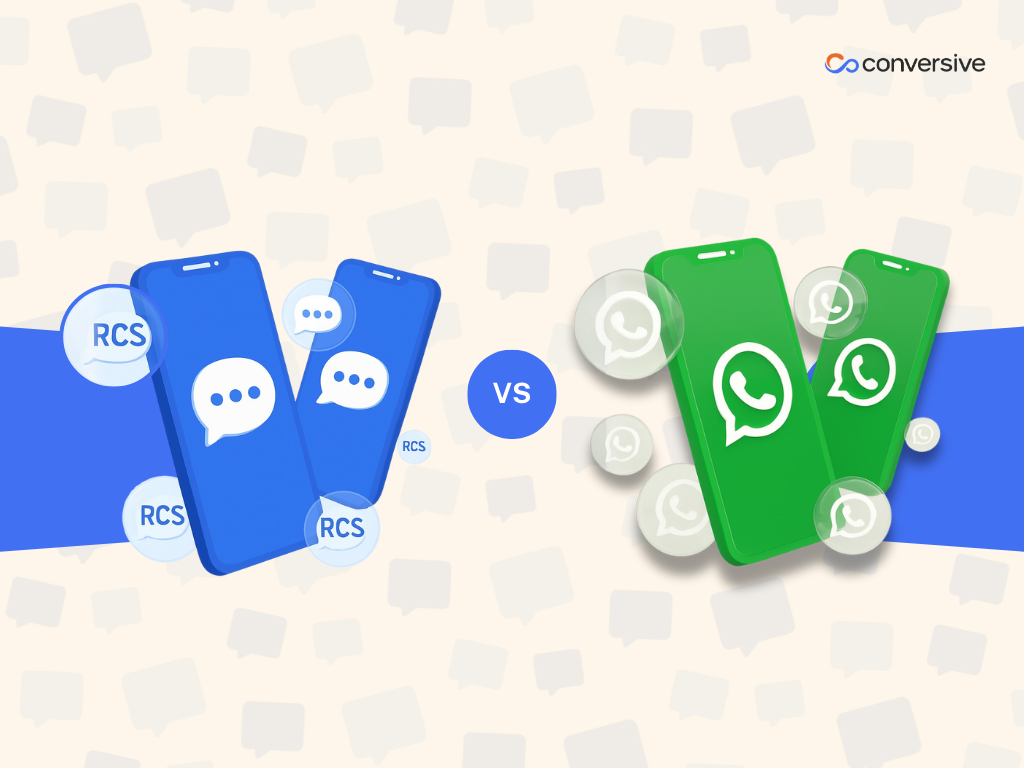
RCS vs WhatsApp: Which Messaging Channel Is Best for Your Business?
The battle between RCS and WhatsApp is shaping the future of business messaging. While WhatsApp dominates with its vast user base and end-to-end encryption, RCS offers a native, carrier-backed alternative with rich media capabilities. Which platform is best for your business? Find out the key differences and strategic advantages in our detailed comparison.
On the surface, RCS and WhatsApp might seem similar because both offer buttons, media, branding, and interactivity but under the hood, they operate in very different ecosystems.
RCS is built into the phone’s default messaging app (like Android Messages or iOS 18+), backed by carriers and phone manufacturers. WhatsApp, on the other hand, is a Meta-owned app with massive global adoption and its own playbook for privacy, pricing, and approval workflows.
At Conversive, we’ve worked with dozens of businesses, especially in regulated industries who need to balance customer experience, compliance, and cost. This guide will help you understand the differences, know when to use each channel, and see how both can work together to create a flexible, high-impact messaging strategy.
What is the Difference Between RCS and WhatsApp in Business Messaging?
RCS (Rich Communication Services) is embedded inside your phone’s native Messages app. That means users don’t need to download anything new. It’s a carrier-managed standard that upgrades traditional SMS with features like rich cards, suggested replies, and carousels. With RCS, the experience feels modern like a mini app inside your default texting app.
WhatsApp, on the other hand, is an over-the-top (OTT) app owned by Meta. It doesn’t rely on telecom networks in the same way RCS does. Instead, it runs through mobile data or Wi-Fi and comes with built-in end-to-end encryption, verified business accounts, and a consistent UX across every supported device.
Here’s the key: RCS gives you reach and control inside the native messaging app. WhatsApp gives you high engagement in markets where it’s already the go-to communication tool.
They’re not mutually exclusive. In fact, many Conversive clients use both depending on whether they’re running outbound journeys (RCS) or nurturing active customer conversations (WhatsApp).
How Do RCS and WhatsApp Compare on Features, Reach, and Branding?
Both RCS and WhatsApp support rich messaging such as images, buttons, quick replies, carousels but they deliver those experiences differently. If you're choosing between them, it's worth breaking things down by functionality and UX control.
Now, let’s discuss them in detail:-
i) Channel Type
RCS is built into the phone’s native messaging app like Google Messages or the upcoming RCS-supported iOS 18 Messages app. It doesn’t require users to install anything. WhatsApp, by contrast, is an OTT (over-the-top) messaging app owned by Meta. It lives separately from SMS/RCS infrastructure and operates using mobile data or Wi-Fi. That means you need your customers to have the app installed before you can reach them.
ii) Reach
RCS reach depends on a mix of carrier support, device compatibility, and OS version. It’s strong across newer Android phones but only recently started rolling out on iPhones with iOS 18. In contrast, WhatsApp has enormous penetration in markets like India, Brazil, and large parts of Latin America and Europe. If your target audience already uses WhatsApp daily, adoption is a non-issue.
iii) Branding
RCS supports verified business profiles that show your brand name and logo inside the messaging thread, though the look can vary slightly across devices and carriers. WhatsApp gives you a verified business account with consistent branding across all devices. Users can see your name, logo, business description, and contact info in a single standardized layout.
iv) UX Consistency
With WhatsApp, the user interface is identical whether your customer is using an iPhone or a mid-tier Android device. It’s designed and controlled entirely by Meta, so you get global consistency. RCS, however, can feel different depending on the phone manufacturer (OEM) or messaging app being used, though Google has worked hard to standardize this on its own Messages app.
v) Message Types
Both channels go far beyond plain text. RCS supports carousels, image cards, suggested reply buttons, and quick actions like “Call Now” or “View Location.” WhatsApp offers rich messaging too like product catalogs, list messages, multimedia content, and quick replies. One difference? WhatsApp currently supports more advanced commerce-style interactions, like in-app payments in select regions.
So if you're looking for brand consistency, WhatsApp wins. But if you want to avoid forcing app installs and leverage the built-in SMS/RCS stack, RCS is your best bet, especially when combined with SMS fallback.
How Do RCS and WhatsApp Compare on Compliance, Privacy, and Control?
When you’re messaging customers, especially in regulated industries like healthcare, finance, or education, compliance and privacy are just as important as engagement. Here’s how RCS and WhatsApp stack up on those fronts:
i) Security and Privacy
WhatsApp is known for its strong privacy foundation. Every message is protected by end-to-end encryption. That means only the sender and recipient can see the content, not even Meta. This makes WhatsApp especially attractive for trust-sensitive use cases, like customer support or account-related communication.
RCS, on the other hand, offers encryption only in some cases. Google’s implementation supports end-to-end encryption for person-to-person chats, but business messages via RCS are not fully encrypted by default, especially when sent through carriers or aggregators. That’s a gap businesses need to be aware of, especially when sending sensitive information.
ii) Compliance and Content Governance
WhatsApp follows strict global compliance standards. Meta requires businesses to collect opt-ins before messaging customers, get templates approved, and follow message window restrictions. This can slow down campaign execution but also ensures alignment with privacy regulations like GDPR, TCPA, and more.
RCS compliance is less centralized. Rules depend on local carriers, CPaaS providers, and sometimes vary across regions. While this allows more flexibility, it also puts the burden on your business to stay compliant across fragmented standards, especially for opt-ins and SHAFT (Sex, Hate, Alcohol, Firearms, Tobacco) content rules.
iii) Data and Ecosystem Control
With RCS, the messaging infrastructure runs through telecom networks and CPaaS (Communication Platform as a Service) providers. This setup gives businesses more flexibility, you can pick providers, create custom workflows, and own more of the messaging stack.
WhatsApp operates entirely under Meta’s infrastructure. While it offers a robust Business API and some control over conversation flows, everything must pass through Meta’s approval layers, including message templates, broadcast rules, and campaign audits.
What Are the Pricing Differences Between RCS and WhatsApp for Business?
If you're deciding between RCS and WhatsApp for large-scale customer engagement, price will inevitably come up but it’s not just about the cost per message. You’ll want to look at pricing models, how costs scale with usage, and what kind of ROI each channel can deliver.
RCS Pricing: Flexible and Session-Based
RCS pricing is typically based on message volume or session windows, with rates set by mobile operators or CPaaS providers. In many cases, it’s cheaper than WhatsApp, especially for outbound campaigns like reminders, promotions, or surveys. That’s because RCS rides on telecom rails and doesn’t involve the kind of centralized pricing control Meta imposes.
However, RCS pricing can vary significantly by country, carrier, and provider so your total cost might fluctuate based on region. Some providers also bundle RCS with SMS fallback, which adds a layer of reliability but may increase costs if fallback gets triggered frequently.
WhatsApp Pricing: Conversation-Based and More Structured
WhatsApp uses a conversation-based pricing model, where you're charged per 24-hour window based on message category (e.g., marketing, utility, authentication). Marketing conversations tend to be more expensive than utility-based messages, and costs vary by geography.
Starting in 2025, Meta is moving toward per-message billing for certain regions and categories, which may impact costs further, especially for high-frequency use cases.
That said, WhatsApp often delivers higher response rates and richer UX, which can increase conversion and justify the higher spend. For instance, a two-way sales conversation that results in a closed deal might be worth much more than a lower-cost RCS blast that gets no engagement.
So What Should You Consider Between RCS and WhatsApp?
Don’t compare just the cost per message. Look at cost per conversion or cost per response. If WhatsApp gives you better returns despite being more expensive, it may be the right fit for high-value or high-intent journeys. Meanwhile, RCS is great for outbound reach and scale, especially when tied to fallback logic and cost-control mechanisms.
When Should Businesses Use WhatsApp vs RCS in Their Messaging Mix?
WhatsApp, is like a well structured and polished “private” road with its own rules and boundaries. While RCS is an open highway, with endless possibilities. To make things clear, let’s go through the following distinctions:
Choosing between WhatsApp and RCS is about aligning the channel to the message, the customer, and the outcome you want. Here’s when each channel shines:-
Use WhatsApp when:-
1. Your audience lives on WhatsApp.
If your customers are in regions like India, Brazil, Latin America, or parts of Europe, WhatsApp is a no-brainer. Penetration is high, and people are used to interacting with businesses via the app.
2. You need encrypted, trust-based communication.
WhatsApp's end-to-end encryption and strict opt-in policies make it ideal for sensitive or high-trust interactions. Think: financial updates, healthcare consultations, or 1:1 customer service conversations.
3. You’re running two-way journeys like sales, support, or commerce.
Whether you’re guiding someone through a product catalog, handling post-purchase issues, or re-engaging leads, WhatsApp’s interactive UI (quick replies, list messages, payment integration) makes it the better tool.
Use RCS (With SMS Fallback) when:-
1. You want to avoid forcing app installs.
RCS lets you send rich, branded messages within the default Messages app on Android (and soon iOS), so there's no barrier to entry.
2. Your current messaging is SMS-based and you want to upgrade UX.
If you're already using SMS through 10DLC or short codes, RCS offers a natural evolution. With RCS, you can add images, buttons, and branding to your messages without changing much of your backend logic.
3. You’re running outbound campaigns like reminders, updates, or promos.
RCS works well for structured, outbound flows: think appointment confirmations, onboarding sequences, and event alerts, especially when you combine it with SMS fallback to ensure reach.
How Conversive Supports Both RCS and WhatsApp with a Unified Strategy
You shouldn’t have to choose between reach and richness, security and scale, or compliance and creativity. Conversive helps you get the best of both RCS and WhatsApp without the complexity of managing two separate messaging systems.
i) Unified Orchestration Across Channels
Conversive intelligently chooses the best-fit channel based on device type, region, and user preferences. If a user can receive RCS, they’ll get a rich native experience. If not, it can automatically fall back to SMS or switch to WhatsApp if that’s preferred or more effective.
ii) Built-in Consent and Compliance Handling
From WhatsApp template approvals to RCS opt-in tracking, Conversive helps you manage compliance at scale. You get full audit trails, secure message storage, and built-in support for frameworks like TCPA, GDPR, and HIPAA which is critical for regulated industries.
iii) Shared Analytics and Cross-Channel Insights
Rather than juggling different dashboards for each channel, Conversive brings together performance data from SMS, RCS, and WhatsApp in one place. You can track delivery, open rates, clicks, replies, and even sentiment across journeys and cohorts.
iv) Ready-to-Use Messaging Flows
Conversive offers prebuilt flows tailored for healthcare, finance, real estate, and education. Whether you're sending appointment reminders or guiding customers through product selection, you can plug into workflows that already support both RCS and WhatsApp logic.
Talk to Conversive Messaging Experts to balance privacy, engagement, and cost with RCS and WhatsApp.
Frequently Asked Questions
What is the key difference between RCS and WhatsApp for business messaging?
RCS is built into the native messaging app on Android (and soon iOS), offering rich media, carousels, and branded interactions without needing an app install. WhatsApp is a standalone app owned by Meta, with end-to-end encryption and a consistent experience across the globe. RCS uses carrier infrastructure; WhatsApp uses the internet.
Which channel offers better privacy and encryption?
WhatsApp provides full end-to-end encryption by default even for business messages. RCS varies: personal messages may be encrypted, but business RCS messages are not always encrypted and standards vary by provider and region.
Is RCS available on iPhones?
Not yet. But that’s changing. Apple has announced RCS support starting with iOS 18, but rollout and full feature parity will take time. For now, businesses targeting iPhone users should include SMS fallback or use WhatsApp for guaranteed delivery.
Which is more expensive between RCS and WhatsApp?
WhatsApp is typically more expensive, especially for marketing use cases, due to its conversation-based pricing. RCS pricing varies by country and carrier but is usually closer to SMS rates. That said, WhatsApp often delivers higher conversion for sales and service flows. So consider cost-per-conversion, not just cost-per-message.
Should businesses use both RCS and WhatsApp?
Yes. They serve different purposes. WhatsApp is ideal for interactive support and sales conversations, while RCS excels in rich outbound messaging inside the phone’s native app. With a platform like Conversive, you can orchestrate both from a single CRM workflow.


.png)

Explore More