.png)
Messaging Is Entering Its Platform Era: Why RCS Is the Future of Business Messaging
RCS is reshaping messaging into a secure, interactive platform for businesses and customers. With rich media, verified sender identity, and cross-platform support, RCS goes far beyond SMS. As Apple and Google align on standards, RCS is quickly becoming the foundation of next-generation customer communication.
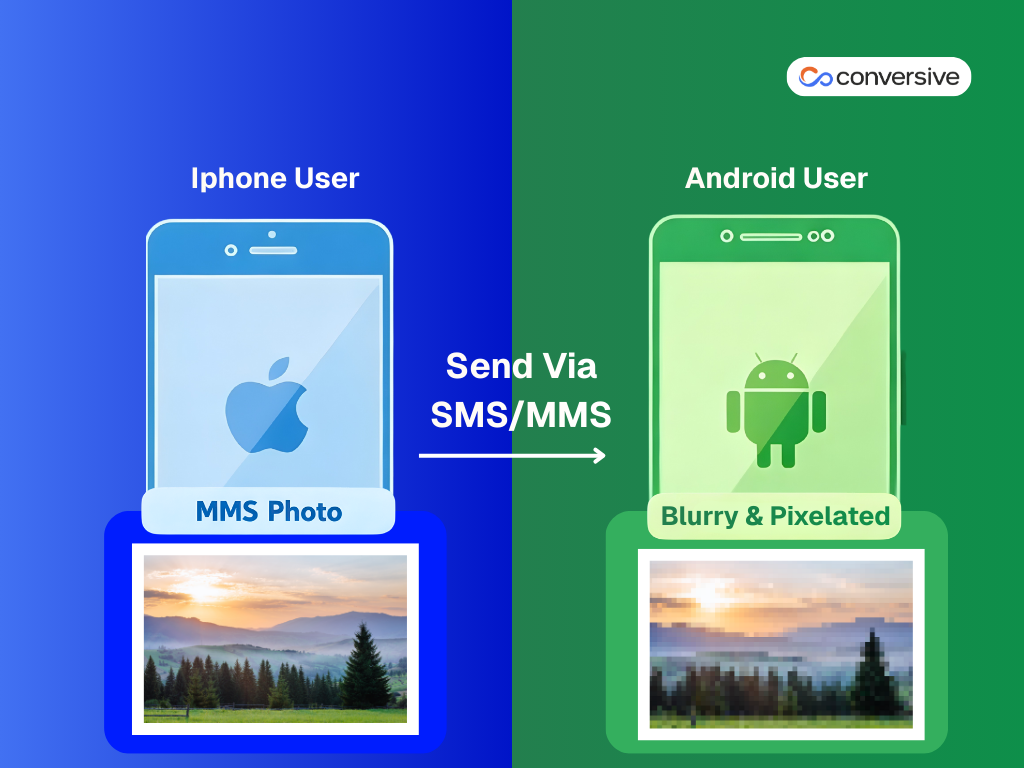
Remember when a perfectly crafted message with photos turned into a pixelated fiasco the moment it left an iPhone and landed on an Android device?
For almost a decade, that tiny moment of friction has been slowly changing the way billions of people talk and interact with each other. The messaging landscape is undergoing a shift, and most people have no idea it's happening right under their noses.
RCS (Rich Communication Services), is the messaging protocol that's quietly rewriting the rules of how the world communicates. Whether you're building customer experiences or managing product strategies, this technology deserves attention.
With 3.2B + RCS-enabled devices, 35% higher engagement vs SMS, a 74% average open rate, and 3x conversion improvement, RCS is already transforming business messaging, at scale.
What Is RCS and How Is It Different From SMS?
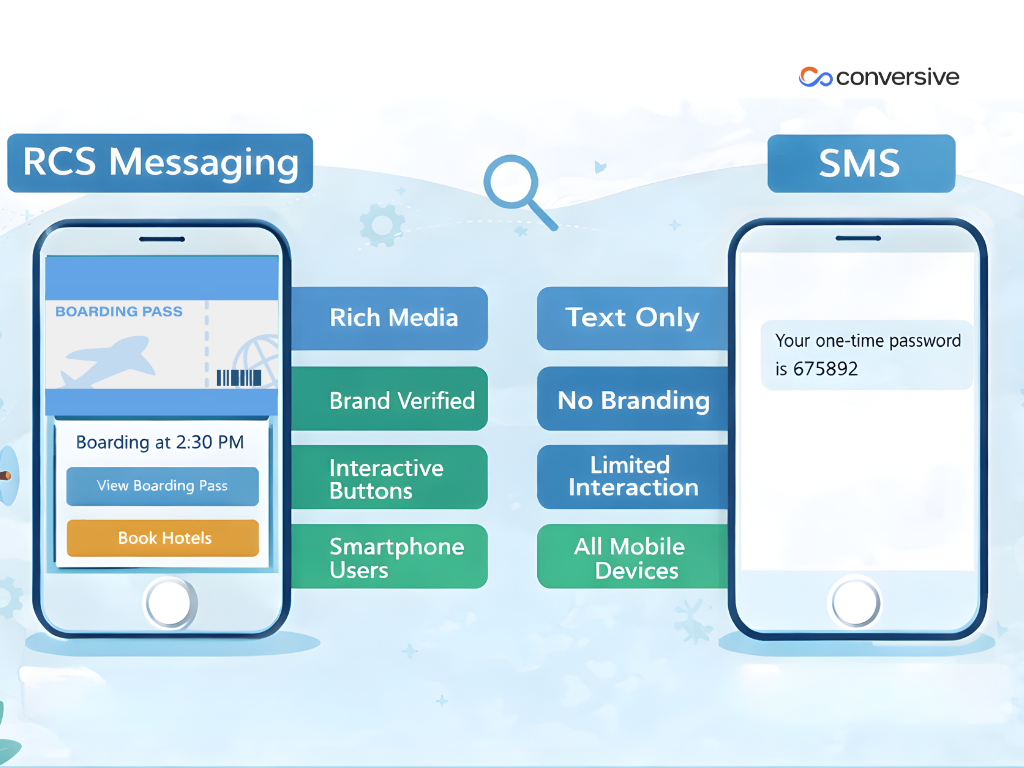
Let’s start with SMS first, SMS is like a postcard, where everyone can read the text, which means zero privacy and content is limited. RCS on the other hand, is more like a private courier delivering a multimedia package with read receipts and encryption options.
Rich Communication Services represents the GSMA's (Global System for Mobile Communications Association) Universal Profile specification, a standardized framework that allows carriers and device manufacturers to deliver advanced messaging features natively through default messaging apps.
No downloads, no separate apps, no fragmentation.
The technical foundation sits on IP-based data transmission rather than the archaic circuit-switched networks SMS relies on. In simple words, RCS uses modern internet protocols, not the old voice-call infrastructure, giving it richer capabilities and advanced analytics that SMS could never deliver.
This shift unlocks capabilities beyond SMS, that is,
- high-resolution media sharing (up to 100MB per message)
- group chats that actually work
- location sharing
- read receipts
- typing indicators
- end-to-end encryption
The delay in widespread adoption has been primarily organizational rather than technical. Getting global carriers, device manufacturers, and platform providers to align on a single standard requires coordination at a scale that's genuinely difficult. But that alignment is finally happening.
As this alignment improves, real-world feature consistency is also improving , though not all capabilities are universally available yet. The table below shows the current state of RCS feature support.
Why RCS Is Built for Modern, Cross-Platform Messaging
Let's explore what RCS brings to the table, because the feature list addresses pain points that have frustrated users and businesses for years.
Rich Media Sharing Without the Compression Nightmare
A 4K video sent via RCS arrives clear and viewable immediately without downloading sketchy files from links. The file size is up to 100MB in many implementations, which means this limit is supported by some carriers, devices, or messaging apps, but not necessarily all.
The breakthrough here isn't just capacity, it's user experience.
When sharing a PDF contract, high-res product mockup, or location data, RCS maintains fidelity while providing real-time delivery status.
For businesses, this means customers can receive detailed product catalogs, visual troubleshooting guides, or rich media presentations without quality degradation or delivery failures.
Verified Sender Identity
This is where enterprise applications get exciting. Google's RCS Business Messaging now allows verified sender badges, those blue checkmarks that actually mean something. When a bank sends a message, recipients know it's actually the bank, not a phishing operation from who-knows-where.
The agent verification process has evolved significantly. Developers can now upload PDFs within the Agent Verification Info section, streamlining launches when carriers require brand approval letters.
These operational improvements signal ecosystem maturity and readiness for large-scale enterprise deployment.
Rich Cards and Interactive Experiences
Google recently optimized notifications for rich cards and carousels, meaning users can now see media previews along with titles and descriptions directly in notifications. This seemingly small enhancement fundamentally changes engagement dynamics.
Let’s say while booking a flight, instead of a text confirmation, the recipient receives an interactive card showing flight details, gate information, a QR code for boarding, and action buttons to add it to calendars or request changes. All without leaving the messaging app.
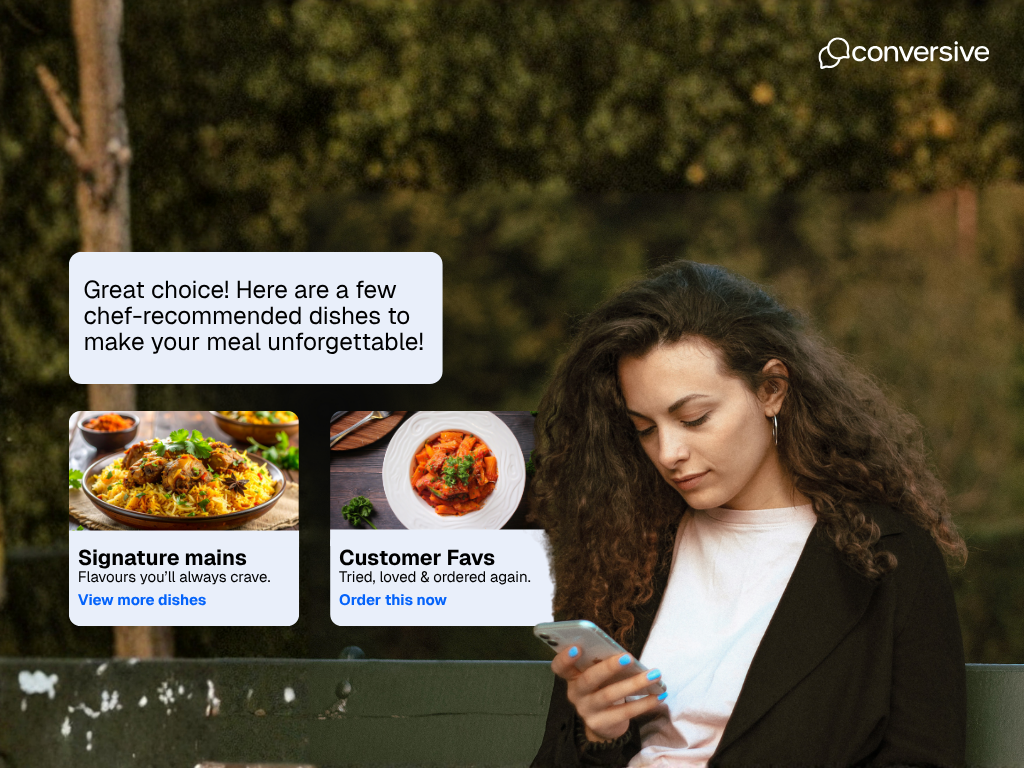
The carousel functionality allows businesses to showcase multiple products or options within a single message thread. Retail implementations enable customers to browse entire catalogs, make selections, and complete purchases without ever opening a browser. The conversion rates are significantly higher compared to traditional SMS campaigns.
In fact, RCS drives measurable results, it has 7× click rate vs Rich SMS, 2× visibility, and 86% higher read rate than newsletters, making it a powerful channel for customer engagement and conversions.
Read Receipts and Typing Indicators
Read receipts can be anxiety-inducing in personal contexts. But from a business communication standpoint, knowing a customer received and read that shipping notification or appointment reminder changes everything about service delivery and support escalation.
The psychological aspect matters too. When customers see that triple-dot typing indicator from support teams, they know someone's actively working on their issue. It transforms the experience from “shouting into the void” to “having a conversation”.
Apple’s RCS Support and What It Means for iPhone and Android Messaging
For years, Apple's resistance to fully implementing RCS created a bizarre digital divide. Android users lived in the future while iPhone users received green bubbles and degraded experiences when messaging outside the Apple ecosystem.
Something significant is happening. Apple is actively developing end-to-end encryption support for RCS messages, expected to arrive with iOS 26.3.
Understanding what this means requires context:
When Apple ships E2EE for RCS, the industry will finally have secure, feature-rich messaging that works seamlessly across the two dominant mobile ecosystems.
Conversations with Android users will be just as private and feature-complete as iMessage conversations. The implications for global communication standards are staggering.
According to reports from GSMArena and Android Authority, Apple has been testing encryption support in beta builds. The Times of India, suggests this could finally fix,
"the biggest problem in iPhone and Android messaging that users have complained about for years."
Having said that, Apple's current RCS implementation still has growing pains. Community feedback highlights UX inconsistencies and behavioral quirks that need addressing. Apple appears committed to fixing these issues, they're not just checking a compliance box, they're building toward a quality experience.
Google’s Role in RCS Adoption and Business Messaging Standards
Google deserves credit for playing the long game on RCS. They're not just maintaining the protocol, they're actively innovating on top of it.
Samsung isn’t fully building its own Universal Profile-compliant RCS system anymore. Instead, it leans on Google Messages and Google’s RCS backend to give users reliable, consistent RCS messaging on most Galaxy devices.
Beyond the rich card preview improvements mentioned earlier, Google is adding new traffic limits for promotional RCS for Business agents in India. These limits control how many people an agent can message within a given time period. This refers to RCS agents that send marketing or promotional messages (offers, discounts, announcements), not purely transactional messages like OTPs or order confirmations.
- A unique user = one phone number / customer
- Messaging the same user multiple times still counts as one unique user
- The limit is measured over a rolling 28-day period
So if your limit is 10,000 unique users:
- You can message 10,000 different people in 28 days
- Sending 5 messages each to those same 10,000 people is fine
- Messaging an 10,001st new person would be blocked
Each RCS agent has a reputation score, which Google determines using factors like:
- Spam complaints
- User blocking/reporting the agent
- Opt-in/opt-out behavior
- Compliance with RCS business rules
- Message quality and relevance
Higher reputation → higher unique-user limits
Lower reputation → stricter limits
Every new RCS agent starts with a low reputation by design. You don’t launch at scale. You earn it.
RCS Is Turning Messaging Into a Permission-Based, Trust-Driven Ecosystem
RCS is moving messaging from a distribution channel to a permissioned ecosystem. This mirrors what happened in email, SMS, and even payments:
- Early chaos
- Spam and abuse
- Platform governance
- Trust becomes infrastructure
According to Mordor Intelligence, Application-to-Person (A2P) traffic accounted for 61.32% of the RCS market in 2025, while Person-to-Application (P2A) traffic is projected to grow at a 30.75% CAGR through 2031.
This shift explains why governance, consent, and reputation are being embedded directly into the protocol. Now the moat that RCS has is, governance, which is embedded before abuse reaches irreversible levels. In practical terms, this means:
- Volume without consent no longer works
- Frequency without value becomes a growth blocker
- Reputation compounds over time, positively or negatively
Therefore, messaging is no longer “send and hope”, it’s build, earn, and scale.
RCS Is Tackling Spam and Messaging Fraud at the Protocol Level
But governance alone doesn’t make a communication ecosystem trustworthy, it must also be transparent and user-respecting. Even the most well-intentioned rules fall short if users don’t know what’s happening with their messages or how their privacy is protected.
Privacy vs. Features
End-to-end encryption is non-negotiable for personal communication. But there's a little complexity, some of RCS's most powerful business features, such as, message tracking, analytics, spam detection, require some level of message inspection.
The solution lies in clear separation and user consent. Personal RCS messages should be E2EE by default, while business RCS messages can operate under different privacy models, but only with explicit user understanding and granular controls.
The industry needs standardized privacy tiers:
- Personal Encrypted: E2EE, zero data collection, user controls all aspects
- Business Standard: Delivery tracking, basic analytics, clear privacy policies
- Business Rich: Advanced features, explicit opt-in, transparent data usage
The Spam and Scam Problem
RCS's rich capabilities make it an attractive target for bad actors. A scammer can also acquire a verified badge and rich card capabilities, which is genuinely concerning.
The long-term solution demands a multi-layered approach:
- Carrier-level filtering using AI to detect suspicious patterns
- Mandatory verification for all business senders with ongoing monitoring
- User reporting mechanisms that actually trigger swift action
- Reputation systems that accumulate trust signals over time
Google's spam protection in Messages has improved, but this needs industry-wide coordination. GSMA should establish and enforce strict anti-abuse standards as part of Universal Profile certification.
The Digital Divide Concern
As RCS becomes standard, there's a risk of creating new exclusion patterns. Older devices, budget smartphones, regions with carrier resistance, these could become communication underclasses.
Responsible deployment looks like this:
- Graceful fallback to SMS/MMS when RCS unavailable
- No critical services exclusively on RCS (at least for the next 2-3 years)
- Pressure on carriers and manufacturers to bring RCS to budget devices
- International cooperation to ensure global access
Building RCS Into Customer Communication and Messaging Infrastructure Strategy
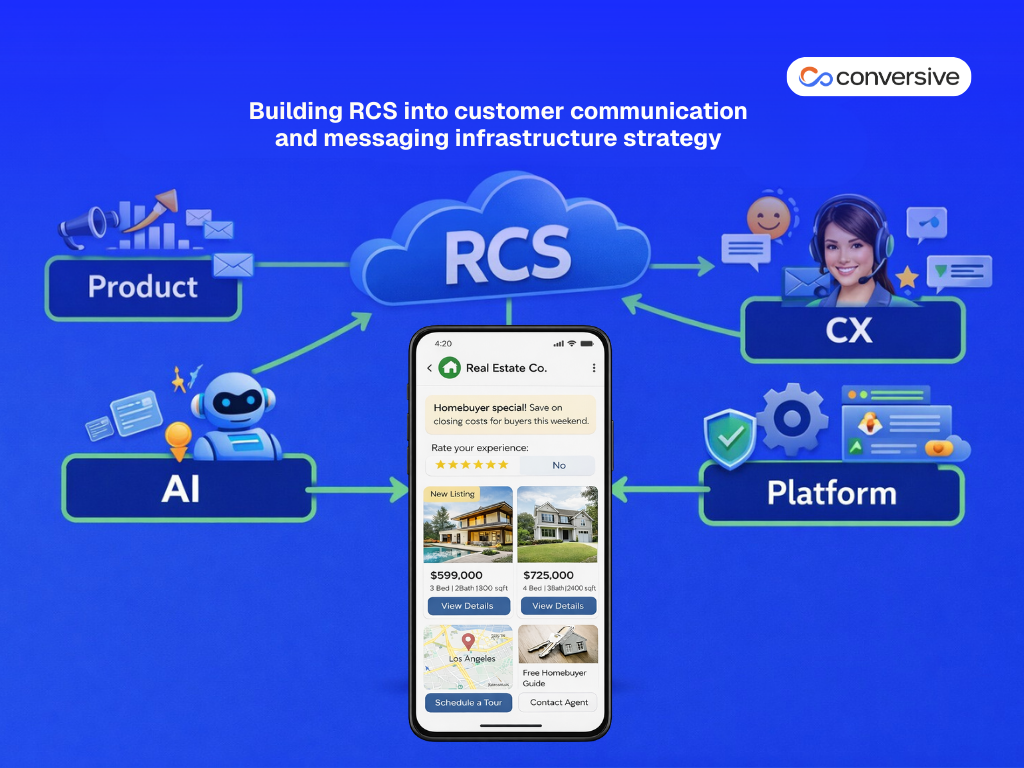
If you're building customer experiences, developing communication products, advising on digital strategy, or designing messaging infrastructure at scale, here's what deserves focus:
For Product Managers
Start experimenting with RCS Business Messaging now, even if customer bases aren't 100% covered. The learning curve is real, and early movers will understand the medium's nuances before competitors catch up. Test rich cards for product discovery, interactive appointment scheduling, customer service escalation paths.
Build with fallback in mind. RCS experiences should degrade gracefully to SMS when needed, not break entirely.
For CX Leaders
RCS enables customer service experiences that genuinely differentiate. Imagine resolving complex support issues through rich media sharing, interactive troubleshooting guides, real-time agent communication, and interactive suggested replies and action buttons that speed up issue resolution all in the native messaging app customers already use.
Measure beyond open rates. Track interaction depth, resolution time reduction, customer satisfaction improvements. RCS provides behavioral data that SMS never could.
For Designers
Think beyond text and buttons. RCS supports carousels, maps, video, audio, rich media layouts, design for the medium's capabilities, not SMS's constraints.
Test on actual devices across ecosystems. The iPhone RCS experience differs from Samsung differs from Google Messages. Design for the common denominator while leveraging platform-specific enhancements where they exist.
For AI Strategists
RCS's structured data formats align beautifully with AI systems. Rich cards translate to machine-readable schemas. User interactions provide training data for intent recognition. The closed-loop nature of RCS conversations enables AI agents to operate more effectively than fragmented omnichannel approaches.
Consider how conversational AI can leverage RCS's interactivity, dynamic product recommendations via carousels, contextual support through rich media sharing, proactive service delivery triggered by user behavior.
Key Implementation Considerations
Feature Comparison Table
RCS Use Cases Across Industries
Industry Application Examples
Key Takeaways
Let's distill this into actionable insights:
RCS is becoming the closest thing to a cross-platform default messaging baseline, but true universal messaging still depends on full RCS feature rollout, carrier support, and whether proprietary systems like iMessage remain dominant.
End-to-end encryption isn't optional, it's the foundation of trust. Apple enabling E2EE for RCS removes the last major credibility gap and fundamentally changes RCS adoption dynamics.
Business messaging transformation is happening now. Rich cards, verified senders, and interactive experiences fundamentally change customer engagement dynamics.
Ethical implementation requires deliberate choices around privacy, spam prevention, and accessibility. Technology capability doesn't equal responsibility, that must be built in intentionally.
The developer experience continues improving with streamlined verification, better documentation, and expanded capabilities. Now's the time to start building and experimenting.
Universal Profile compliance isn't negotiable. Fragmentation kills network effects, everyone needs to implement the standard fully, or the promise falls apart.
Think platform, not feature. RCS isn't just SMS 2.0, it’s emerging as a native communication layer capable of enabling new interaction models and business ecosystems.
Design Better Customer Conversations With RCS
The technical foundation is solid and the business incentives are aligning. So the recommended approach is, start small, learn fast, and think big. Test RCS Business Messaging with a segment of your audience. Measure what works.
Most importantly, design for people, not protocols. RCS is a tool, an incredibly powerful one, but the goal remains meaningful, secure, delightful communication between humans.
If you're exploring what RCS could mean for your customer experience, Conversive helps brands move from experimentation to real-world deployment, connecting strategy, platform integration, measurable outcomes across the RCS ecosystem, and continuous optimization through data and insights. Book a demo today!
Frequently Asked Questions
What makes RCS different from WhatsApp or other messaging apps?
RCS is a protocol, not an app. It works natively in default messaging apps without requiring downloads or separate accounts. While WhatsApp requires both parties to have the app installed, RCS works cross-platform through native messaging clients.
Will RCS work if the recipient doesn't have it enabled?
Yes, through automatic fallback. When RCS isn't available on the receiving device or network, messages automatically downgrade to SMS/MMS. The sender's device handles this transparently, ensuring message delivery even if the enhanced features aren't available.
Is RCS secure enough for sensitive business communications?
With Apple's upcoming E2EE implementation, personal RCS messages will have end-to-end encryption comparable to iMessage or Signal. For business messaging, RCS offers verified sender identity and secure transmission, though businesses should evaluate specific compliance requirements (HIPAA, GDPR, etc.) based on their use case.
How much does RCS cost for businesses to implement?
Costs vary by provider and implementation approach. Some carriers offer RCS Business Messaging directly, while platforms like Google's RCS Business Messaging provide API access. Pricing typically involves per-message fees (often comparable to or slightly higher than SMS) plus potential platform or verification fees. The ROI often justifies costs through higher engagement and conversion rates.
Can RCS replace email for business communication?
For certain use cases, yes. Transactional messages, customer service interactions, appointment reminders, and promotional campaigns often perform better via RCS due to higher open rates and interactivity. However, email remains superior for long-form content, complex document attachments, and scenarios requiring permanent archival records.


.png)